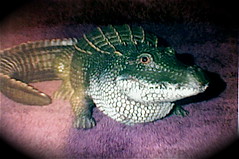
Like something out of that Pirandello play in which six characters were in search of an author, when I first met up with Virgil, I was an author in search of a subject. Now I'm blogging, and things haven't really changed. Blogging requires a subject, too, and sometimes there just isn't one. Nothing comes to light. Nothing catches fire. And so here I am, climbing the air again as if it were a flight of stairs.
Here I am with nothing to go on, wondering how I'll make it to the next perfect sunset. Would I even recognize the scent of something that is coming close? The question I keep asking myself is, can I cross the river without a boat?
Annie Dillard says that for the writer maybe it isn't the subject that counts, but writing itself--being in the dance. She claims a subject is simply a quality that some things possess and others do not.
Virgil says that all you really need to blog is to stick with walkie-talkie immediacy. "Let's be clear about one thing," he says, twirling an elegantly proportioned chrome-plated baton (where on earth did he get that thing?). "This is a rave, so you have to put all the boring stuff behind you."
As for me, today, I can't even think of my five-digit PIN number. Where do ideas come from anyway?
"If you get really stuck," my sticky, voluptuous, fascinating alligator-friend offers, "you can ring me up and I'll play the ace with an IV-feed of unearthly chit-chat. But whatever you do, don't argue with reality. Enjoy your affinity for fish and chips. Just stay put and watch the world go round."
Tuesday, June 19, 2007


Friday, June 15, 2007
Wriggling
If we are to believe the Hindu legends, the human race will end in fire, before it all begins again. At that point the rulers of the earth will have degenerated into plunderers.
So what else is new? Virgil, my beloved, transrealmic alligator-muse, prefers to disappear and take a break whenever he sees me getting my knickers in a twist over what he calls the "Oil Wars." He spent this past week hanging out in the Louisiana bayou with Barbara Hurd, the woman who wrote his most favorite book in the whole world. The book is called "Stirring the Mud," and it's all about swamps.
In her book (which I've read, too, since Virgil insisted I learn more about his native habitat), Hurd describes swamps as places of transition and wild growth, breeding grounds for organisms and ideas at the edge of civilized thinking. Swamps exude a feral magnetism and a raw mythic power that are good for the soul. Perhaps because they are so primordial and shapeless, they are places where you can wander and lose your bearings.
"Swamps," she writes, "will not lead you back the same way you came in. The trick is to learn how to wander there without intention, to float eye-to-eye with fringed orchids, to make yourself available to what lives there...."
Hell, she makes it sound like blogging!
Virgil has come back full of excitement about poling on the north side of the cove with Hurd and her Cajun boatman, Cyrus. At one point Cyrus tossed a few marshmallows into the water as bait. After a while he pointed suddenly with his finger to something waterlogged and fastened in the mud. It was an alligator, twenty feet long.
"That's Oscar," Cyrus said. And then Oscar and Virgil (who has political connections everywhere), immediately began hugging, as if they hadn't seen each other in a hundred years. It seems that he and Oscar go way back. Then they both angled downward, wriggling and diving and playing in the opaque broth of the swamp.
Sometimes Virgil acts as if he belongs in the real world. He's become such a good wriggler that I guess he can wriggle any way he chooses now.
"I'd love to be able to convey to you the sensational sense of freedom the wriggling experience implies," he tells me, "but no amount of words can really explain it."
Still, based on the buzzy look in his eyes and galvanized by his recent encounter, I think he's glad to be back blogging again, living as it were in a fool's paragraph.
Tuesday, June 12, 2007
A New Direction
After writing, in my last post, my response to friend Cliff's unpublished letter on the Iraq war, it occurred to me to post my own unpublished letter on the same topic, written to the Roanoke Times, prior to the start of the "surge." The letter includes my own advice to the president at the time. It was actually accepted for publication, but it never actually ran in the paper as there was a mass exodus in the editorial staff a couple of weeks later, and a distinct change, after that, in the kind of essays they publish. (Our local newspaper has never quite recovered from the loss of those key members of its former staff.) Beyond that, let me say only that this war has become a chronic and soul-sapping illness in the body of our country. I therefore add this question for my readers, inviting answers:
If a nation is despised by its own citizens, what happens then?
A New Direction
By Suzi Gablik
If you are a writer, the assimilation of important experiences obliges you to write about them. Writing is how you take possession of an experience and make it your own. We live now in an era over which terror rules and has us trapped in an unhealthy relationship with fear. Fear is where my personal consciousness connects with the global consciousness. If I can master my own fear, I like to think I might be doing something for my country. Or even for the world. The point being that it's always a matter of how we work with our minds.
These days, I have developed an unseemly interest in the mind of George W. Bush. It is part of my quest to understand this war on terror. Ever since he told the world, after 9/11, that "Every nation in every region now has a decision to make. Either you are with us, or you are with the terrorists," Bush has set in motion a seething landscape of polarities. But were these really ever the only possibilities? Even now, is this all anybody can imagine?
Polarizing ideologies have finally brought us to this place where consciousness has become a wall against which something happens: the rigidities of position-taking. And in this polarized world, no one is ever guilty of aggression, only of retaliation. Everything is always somebody else's fault. Thus the burden of insults gets passed around the system, but is never removed.
My own mind seems to function quite differently from that of George Bush's. Where he sees chronic dichotomies, I see the complexities of an elegantly balanced system of interlocking forces. I see a world that does not conform to manipulated separations, but curves right over them, traversing the dichotomies and overlapping itself in contrapuntal layers, refusing to have its richness reduced to simplistic truths. I see our country in a period of contraction, engulfed in failure, defeat, and sorrow; yet, in some deep perversion of administrative process, I hear a president who remains eternally buoyant and optimistic. When alarming facts are given, he offers reports of success still to come. Looking at the roots of terrorism doesn't seem to be part of the plan. Instead, he continues to devise new strategies to "win." I hear him say that and I wince. Are those pearls that were his eyes?
Radio entertainer Garrison Keillor recently portrayed the president as a "decider" preparing to "surge" the studio if he isn't admitted to the show. Quite funny, you say. But the man who laughs, as Bertolt Brecht once exclaimed in a poem, just hasn't heard the terrible news. Surge or no surge, Iraq is not our country and we don't belong there. It has to be obvious by now that increasing the troops is not going to change the profile of the U.S. in the Arab world. More likely, it will serve to increase momentum for jihadist recruits on the other side, as more and more Muslims view Islam as being under attack and see America's foreign policy as imperialist, advocating preemptive war. We have entered a hall of mirrors in which every step toward a goal leads to two steps away from the same goal.
So, Mr. President, if it were up to me, this is what I would have to recommend:
Know that your country, however large it may be, is only one point on the cosmos. Cultures are very different from each other, and their laws may not bend to the human will. By now it should be clear that exporting democracy to countries where we have no shared heritage is a perverse project, not something you can make up as you go along. Decentralize your complacency. Someone must be willing to report back from hell and say, "It seemed like a good idea at the time, but this hasn't worked out."
One of the qualities proper to reality is that of possessing perspective, that is, of organizing itself in different ways so as to be visible from different points of view. Rejoice in surrounding yourself with fragments whose muddled nature you have now come to appreciate.
Once you have experienced the full extent of your interconnectedness with everything and everyone, concentrate hard. You may find yourself becoming just a little less absolutist, a little more fluent. Whatever happens, do not, at that point, fall into longing for your old certainties. Befriend the loss of your power. Surrender that glorious image of yourself as one of the good guys, mighty and righteous, laying snares for our evil enemies. Remember, the enemy is always evil, for doing much the same things as one does oneself.
Sunday, June 10, 2007
Pipe Dreams
A few weeks ago, an artist friend of mine, Cliff McReynolds, who lives in La Jolla, CA, wrote a letter to the San Diego Union about how to end the Iraq war. The letter did not get printed, and landed instead in my mailbox, with the suggestion that maybe I could do something with it on my blog. The following is a summary of my friend's proposals:
Bush should go before the United Nations and admit our country's failure in responding to terrorism by invading other countries, causing more death, destruction, and hatred, and creating even more enemies than we had before.
He suggests that we in the U.S. become more knowledgeable about Islamic culture, history, religion, and society so that we better understand the people we are dealing with, and can learn to distinguish between moderate Muslims and fanatical extremists. We need to treat the two groups very differently, he feels, because we still need to capture or kill the extremists.
He proposes that we listen to Muslim grievances against us and try, in good faith, to correct them. In this way, moderates will gradually come to trust us and be won over to our side, and not become recruits for militant Islamists. To succeed on this path, however, we will need to put our own fears, anger, and hatred behind us, and become more generous and fair towards Islam, thus guaranteeing that they will ultimately respond in kind. Then, presto ipso facto, we can overcome evil with good.
Thinking about all this, what kept coming into my mind over and over again was a painting by Rene Magritte, in which there is an image of a pipe with an inscription below it that says "This is not a pipe."
I realized there was nothing my friend said in his letter that I could fault, nothing that I even disagreed with, yet the letter made me feel uncomfortable with its incongruity, much as Magritte's painting makes people uncomfortable when they first encounter it.
Gradually I was able to understand the connection between the painting and my reaction to my friend's letter. The letter is like the painted image of a pipe: not to be mistaken for a real pipe. In other words, I can't imagine Bush ever admitting his failure at the U.N. My friend's scenario on paper is not the same as any real-world scenario.
Personally I would totally underwrite the U.S. addressing Muslim grievances, but even the most acute responsiveness at this point will not be able to alter the basic radical Islamist vision--which not only rejects the concepts of democracy, secularism, and pluralism, but believes that all non-Islamist governments must be brought down. If we really begin to educate ourselves on the subject of jihadism ( something which I have personally been doing for the last year), what we will learn is not that some sort of accommodation is possible, but rather that we have now unleashed forces that we were totally unprepared for, a genie that can't be put back in the bottle. As New York Times columnist Frank Rich wrote some time ago, "For this administration to accept that it is helpless to stem the avalanche it has set off may be even harder than to accept that it has made a terrible mistake."
And finally, when my friend suggests at the end of his letter that we need to put our own fears, anger, and hatred behind us so that Muslims can do the same, and that this is the only way to guarantee that they will respond in kind, I have to wonder if his projection of how human beings are likely to behave is based on some goody-goody image of humanity, or in an understanding of inevitable real-world living. It's not that I don't applaud the noble goals he lays out. Ambition of this sort is not a sin, and pied-pipers must be allowed to dream. The reality is, however, that our moral dilemmas remain, more intractable than ever, even while the mantle of goodness eludes us. Images for ending the Iraq war are not to be confused with really ending the Iraq war. The way I see it, my friend's plan is like Magritte's painting of a pipe because, in the final analysis, you can't smoke either of them.
Thursday, June 7, 2007
Blogging vs Publishing
I think that what I most love about blogging is that you get to write whatever you want without anyone looking over your shoulder. And you don't have to come up with an "acceptable" result. Whenever you are writing for magazines, or publishers, there is always an editor, waiting at the gate, to let you know what you can and cannot do. Kind of like those check points in war-torn places, where you never know if you're going to be stopped, and turned back. As a recently emerged blogger, I find myself free, able to resume my old experiment of trying to discover whether the universe, left to its own devices, is self-organizing. I get to do my own thing, in its raw state, without having to fit myself into somebody else's shape.
Blogging means you can ignore the "demon of progress." You can write in circles if you want, break laws, or traipse around in a flying machine, for all anyone else cares. You don't have to worry whether or not your work is going to "appear." You discharge your business, and you go. If you're lucky you offer someone their best hysterical laugh for the day. It takes exactly one second to post a blog, once it is written.
Of course, in my case it helps having such an ace assistant. Virgil has been really out there these past couple of months, stimulating minds and invigorating bodies. People seem to love his distinctive blend of comic absurdity and exuberant playfulness, convinced that this carbonated character is having a good effect on their immune system. Maybe even causing them to live longer.
When I tell these observations to Virgil, he reassures me that alligators only appear to be dozing in the sun. In truth they are really watching for literal and metaphorical tidbits to come within lunging distance, just like writers do.
"Hand-picked audiences that cheer you on are fine as far as they go," he says, "but I really need something else that will bring in some cash."
Virgil informs me that he's decided to launch a line of high-end apparel for Boomingdale's this year. He plans to mix up a patch of wild animal's mane or tail with the occasional paisley tie, then let it all hang out, in hopes of becoming the toast of finicky fashionistas everywhere. Next thing you know, he'll be wanting his own listing in the yellow pages, too.
Sunday, June 3, 2007
Writing about Art
My phone rang recently, and it was Betsy Baker, the long-time Editor-in-Chief of Art in America and also an old friend of mine, although we are not much in touch these days. She was checking in to see how I was doing after the Virginia Tech shootings, and she wanted to know, was I writing anything these days?
I've got a blog, I told her, and that's pretty much it. I wrote something about the massacre. Then she asked if any of my blogs were about art?
"Ay-yi-yi, no!" Not so far anyway.
Then I got this catalogue in the mail. It listed all the art and technology books scheduled for publication by MIT Press in 2007. I immediately checked it out to see what writers who ARE writing about art are doing. I opened the catalogue at random and my eye landed on a book called "History of Shit" by Dominique Laporte. (I kid you not.)
Whoa! I thought. Here comes my next blog.
"I'm on it," says Virgil, my indefatiguable alligator blogging assistant, his arms windmilling like crazy. The book was listed in the section called Cultural Studies, and the blurb went something like this:
"'History of Shit' suggests...that the management of human waste is crucial to our identities as modern individuals--including the organization of the city, the rise of the nation-state, the development of capitalism, and the mandate for clean and proper language. Far from rising above the muck, Laporte argues, we are thoroughly mired in it, particularly when we appear our most clean and hygienic."
Whatever.
Virgil and I then flipped over to the Art section, where we found a book entitled "Chronophobia: On Time in the Art of the 1960s" by Pamela Lee. The term is one coined by the author to refer to the anxiety and uneasiness about time, embodied in works ranging from kinetic sculptures to Andy Warhol's films. This topic, according to the author, has gone largely unexamined in historical accounts of the period.
How could this happen?
Since good things supposedly come in three's, we decided to choose one more book. Virgil picked his favorite from a section headed Design: "The Aesthetics of the Japanese Lunchbox" by Kenji Ekuan.
The Makunouchi Bento, or traditional Japanese lunch box, is a lacquered wooden box divided into quadrants, each of which contains different delicacies. (Virgil is smacking his lips with pleasure.) The author's thesis is that the lunchbox is a key to understanding the whole of Japanese civilization, from food to television to motorcyles, package tours, landscape, and computers.
"All this sharp writing really gives your brain cuts," says Virgil, mischievously waving his cup of dandelion wine. "Remember Jimmy Durante? How he liked to say 'It's duh toast of duh intellectuals?'" Virgil ostentatiously swigs down the last of his dandelion wine.
"Cheers!" he says, looking positively seraphic in his concentration.
I haven't even mentioned the book with the most intriguing title: "How to See a Work of Art in Total Darkness." In case you are wondering what it's about, it deals with issues of black artists necessarily being viewed in terms of their "blackness," and not really liking it any more. I'm thinking Virgil should apply for a top-level editorial position at MIT Press, don't you?
Saturday, June 2, 2007
Digital Democracy
Sometime during this past year I had an odd dream, in which I was supposed to interview Al Gore. The dream was pretty galvanizing, but since I'm not traveling these days, I didn't see any way to try and follow its promptings. Al Gore isn't coming to Blacksburg any time soon.
Then Arianna pre-empted me. She interviewed Gore this week and wrote about it on her blog, The Huffington Post. As everyone knows, Gore is a passionate advocate for the glories of the Internet, which he sees as a force for good in the world. Most recently Gore has been claiming that digital technology can wrench our democracy back from the grip of the political demagogues who have hijacked it, by establishing "an open communications environment in which the conversation of democracy can flourish" and power can be put back in the hands of ordinary citizens:
"We need to reengage the American people in the process of democracy," he told Arianna Huffington. "We have to convince them that their opinions do matter, that their wisdom is relevant, and that their political power can be used effectively. And the Internet is beginning to bring about some very positive changes in this area -- it's why it is so important that bloggers are now able to hold newspapers and politicians accountable in ways they couldn't even just a few years ago."
However, as the digital fire spreads and Web surfing becomes a way of life, it turns out that we are not the only ones downloading. The Internet has also become a creepy sort of utopia for Jihadis, who believe that the West is waging a universal war against Islam. Radical Islamic groups have come to value the Internet so much for its ability to spread their message, and to help them recruit and train suicide bombers, that it is now as crucial a tool for them as the Kalashnikov rifle. (This is the conclusion of a recent report delivered to the Senate Homeland Security Committee.)
Thus, increasingly sophisticated computer technology is not just helping to create grassroots networks for democracy, it is also creating a global community of apprentice Jihadis on all continents, who want to destroy us, and to dominate the
planet with their 7th-century Sharia ideology.
So, in my own imaginary interview with Gore, this is what I would have asked him about. Yes, the Internet certainly has many benign uses, but it is now also a terrorist's Valhalla. What do we do about that?
It's a bit like the invention of the atom bomb that was originally designed to protect the world from destruction. Instead it has become the most dangerous threat to human survival that is out there.
Subscribe to:
Posts (Atom)