It's been a busy weekend: another one hundred or more Iraqis blown up; eight "Live Earth" concerts on seven continents; and I've finished reading Derrick Jensen's "Endgame," and started in on Daniel Quinn's "Write Sideways," a newly published volume that I found in The Dancing Moon bookstore in Boone last weekend. You have to know something is up when everything that you touch is saying the same thing, when everyone you read is infected with the same spirochete of civilizational wipeout. Or maybe my inner magnet is working more like a compass-in-disguise. Here's a little oratorio from Quinn:
"The people of the world simply must confront the fact that the period of mass extinctions that will end with our own has already begun, and that this isn't something we can just go on ignoring."
Al Gore's definitely not ignoring it. He's created these aboriginal songlines spanning the entire globe that are intended to have revolutionary implications. Can we sing the world towards a saner ecological future? Will Al succeed (where others before him have failed) in changing people's minds? Will I, to pull just one random example out of any random summer hat, be ready to give up my car any time soon?
And back to the older, previous question: Does art have enough revolutionary oomph to change the world? We'll see. I used to spend, as I've already said, a lot of time writing and arguing about that. In the meantime, things have changed drastically for the worse during the last ten years (the past 6 and 1/2 of them under the lobotomizing, traumatizing reign of GWB & Co), and now the planet is in real trouble. Now, the relevant questions are: does the human race have the will to change? and will it manage to survive against poor odds?
We have always assumed, here in America, that our way of life is the superior one, because we are the ones with all the "stuff." We are, after all, arguably the most advanced civilization the world has ever known, surely the most "evolved," and definitely the most envied. (Never mind that all of this comes at the expense of everyone, and everything, else.) Are we finally ready to look at these cultural assumptions?
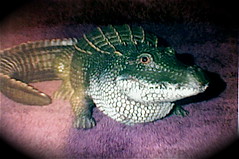
Because I've been so caught up, Virgil--wise old excellency that he is--has taken to reading one of HIS favorite books, the one with the provocative title "Do Alligators Matter?" He received it a few years ago from my good friend Jane Vance, a painter who lives in Blacksburg and works at the Middle School as a teacher's aid. She found the book in a slush pile there, and retrieved it before it got thrown away.
Did you know, for instance, that alligators are related to dinosaurs, and go way back? Unlike the unlucky dinosaurs, however, they did not die out. This has made Virgil a tad cocky about his ability to survive even human extinction as well. "The best strategy," he says, "is just to hang on and see what happens next. If you are not living on your edge, you are probably taking up too much space. And if Kate Moss used banana peels as knickers, she'd triple the economy of Costa Rica overnight."
In the interest of full disclosure, I happen to know that Virgil cribbed this last arty comment from Vanity Fair. He's such a top-notch thief, however, that it's hard to reproach him for his stolen eloquence. He's promised not to indulge too often.
Did you know, Ho-ho!, that most reptiles DO NOT have a voice, but alligators do? Young alligators grunt. A grown male alligator has an earth-shaking bellow, and it makes his glands give off a strange, sweet smell. "It's really useful," says Virgil, "when you're doing fly-on-the-wall reportage."
Some alligators, those with true statesmanship like Virgil, who can double as king of the mambo beat, sometimes even achieve divinely inspired conversation.
Sunday, July 8, 2007


Thursday, July 5, 2007
The Sartre of Appalachia
The current narrative of End Times, and how to look the Medusa in the face, continues. The following comments are excerpted by me from a long essay by Joe Bageant, found on his website by my friend Bob Walker. I don't know Joe Bageant, but it seems as if he, too, has been reading Derrick Jensen. He is described by one reviewer on Amazon as "the Sartre of Appalachia," and his prose as "white-hot and bourbon-fueled." He has written a book, "Deer Hunting with Jesus."
"The Ants of Gaia" (Excerpts)
by Joe Bageant
If mankind were discovered on a dog's hide the owner would give the dog a mange dip. Or if the earth were a Petri dish, we would be called pathology. Problem is though, mama earth tends to shed pathogens off her skin, which for us pathogens, is the ultimate catastrophe.
When forced to look at catastrophe on this order of magnitude, we either go numb in shock or look in delusion to something bigger, or at least something with more grandeur than Mother Nature flushing humanity down the toilet. Otherwise, one must accept the both ugly and the weirdly beautiful prospect of oblivion. Meanwhile, we begin too late to "make better choices." Grim choices that do nothing but postpone the inevitable, which are called better ones and sold to us to make ourselves feel better about our toxicity. Burn corn in your gas tank. Go green, with the help of Monsanto. But not many can be concerned even with the matter of better choices. Few can truly grasp the fullness of the danger because there is no way they can get their minds around it, no way to see the world in its entirety. The tadpole cannot conceive of the banks of the pond, much less the wooded watershed that feeds it. But old frogs glimpse of it.
Still, there is choice available, even a superior choice -- the moral one. Accept the truth and act upon it. Take direct action to eliminate human suffering, and likewise to eliminate our own comfort. We can say no to scorched babies in Iraq. We can refuse to drive at all and refuse to participate in a dead society gone shopping. We can quit being so addicted to the rationality and embrace the spirit. Rationality simply turns back on itself like a mobius strip. Too much thinking, too much cleverness on the monkey's part leads it to believe it can come up with rational solutions for what ration [sic] itself hath wrought.
All the green energy sources and eating right and voting right cannot fix what has been irretrievably ruined, but only make life amid the ruination slightly more bearable. Species gluttony is nearly over and we've eaten the earth and pissed upon its bones. Not because we are cruel by nature (though a case might be made for stupidity) but because the existence of consciousness necessarily implies each of us as its individual center, the individual point of all experience and thus all knowing. The accumulated personal and collective wounds fester and become fatal because there is no way to inform the world that we must surrender our assumptions, even if we wanted to. Which we do not because assumptions are the unseen cultural glue, the DNA of civilization. If we did so, the crash would be immediate.
So we postpone transformation through truth, and stick with what has always worked -- empire and consumption. And we twiddle our lives away thorough insignificant fretting about mortgages and health care and political parties and pretend the whole of American life is not a disconnect. Hell, all of Western culture has become a disconnect. Somebody needs to tell the Europeans too; progressive Americans give them entirely too much credit for the small positive variation in their cultures and ours. We both get away with it only so long as the oil and the entertainment last.
We allow ourselves to imagine the worst is somewhere in yet another future so we can continue without owning decision. Love of comfort being the death of courage, we continue the familiar commoditized life, the only one we have known. Is it not true that our entire understanding of courage as we know it is about braving some unknown? About making the socially unaccepted and dangerous choice? Stepping forward in the face of the wars and evil mechanics of our own particular time?
Empire and its inevitable permanent state of warfare flourishes not because evil men are at the helm, but because the men at the helm are even weaker and more in denial than we are. (Look at Dick Cheney. The guy is a nervous wreck wrapped in arrogance and denial.) And so their uninformed and crude confidence is assuring to both them and us. We elect the worst among ourselves in increasing avoidance of ourselves and they are validated by our endorsement. Evil men seeking empire did not make us or the world this way. We made their existence possible through our denial, love of ease and non accountability.
I thank the stars for younger men, writers such as Derrick Jensen and Charles Eisenstein. They say what we cannot yet say to ourselves and what the media will never say because media survives by the corporate numbers game. Consequently, the iron rules of being allowed to communicate with significant numbers of people within our empire tend to call for glibness, fake optimism, and the wide net of inclusion of even the silliest sorts of people. Fuck only knows I've participated in the sham over the years. But the truth is never politically or socially correct.
So here we are. You and me. Let us hang all our laundry out to dry in this tiny corner of cyberspace. I think it is entirely possible that we can be honest cybernetic bards in an unpromising age, possibly even noble amid the ruins.
(Email Joe Bageant at joebageant@joebageant.com)
Wednesday, July 4, 2007
Three of Three Events (Endgame)
One of the things that will happen to you if you allow yourself to read straight through Derrick Jensen's book "Endgame: The Problem of Civilization," is that you'll have a lot of sand kicked in your face. You'll also feel that your own shelf-life may be about to expire. But rarely have I ever read anything that reaches such high levels of aliveness, absolute honesty, and refreshing courage. Jensen is a touchy writer of almost withering intensity, who believes that civilization has entered its endgame; its destructiveness is consuming the world--starving, imprisoning, and torturing it to death. When he writes about this, it is in a unique, peremptory, take-no-prisoners style.
"In the last 24 hours, over 200,00 acres of rainforest were destroyed. Thirteen million tons of toxic chemicals were released. Forty-five thousand people died of starvation, thirty-eight thousand of them children. More than one hundred plant or animal species went extinct because of civilized humans.
All of this in one day."
He's a firebrand, rhetorically bellicose, unafraid to offend. Which is what I most like about him. Here is a summary of some of his gut-wrenching observations and thoughts, put together loosely by me, in no particular order:
We all face choices. We can have ice caps and polar bears, or we can have automobiles. (Jensen claims that just manufacturing cars is even more polluting than driving them.) We can have dams or we can have salmon. We can have cardboard boxes or we can have forests.
From its opening to its end game, civilization has been nothing if not consistently narcissistic, domineering, and exploitative, with it's central supporting myth of the desirability of growth. What I'm proposing is that we look at our situation. And our situation is that we have overshot carrying capacity. The question becomes: what are we going to do about it?
No amount of comforts or elegancies are worth killing the planet and we have no right to do so. If only we weren't insane. If only there were even the slightest chance our culture would undergo a voluntary transformation to a sane and sustainable way of living. It's an impossible fantasy. There's no accountability in this culture, I must be honest with you, even at the risk of offending or alienating you. Believing that we can convert ever larger numbers of living beings to dead objects, trees or mountains into two-by-fours and beer cans, and that this is the primary goal of life, and making ourselves the beneficiaries of all this insanity and injustice, is insane.
The past few weeks I've been in crisis. I'm scared. Scared to articulate what I know in my heart is necessary, and even more scared to help bring it about. I mean, we're talking about taking down civilization here (before it takes us down). I want to stop the destruction. I want to stop it now. I'm not satisfied to wait for civilization to exhaust its physical and metaphorical soil, then collapse. In the meantime it's killing too many humans, too many non-humans; it's making too much of a shambles of the world. The longer we wait for civilization to crash--or before we ourselves bring it down--the messier will be the crash, and the worse things will be for those humans and non-humans who live during it, and for those who come after.
Jensen can be funny. One of the things killing the world, he feels, is the Detroit Tigers--because people care more about Detroit Tigers than about real tigers. And he hates pious pacifists who shun any use of violence to halt the atrocities. I can't help thinking, as I read him, of those lines by Dylan Thomas: "Do not go softly into that dark night/Rage, rage, against the dying of the light." Reading him is tonic to our incapacity to really face our predicament. For most people, it's too difficult a truth to share: that we're really fucked. It comes off, jensen says, as hope-bashing. (More on that to come in a subsequent post.)
"Two days ago," he writes, "I was at a meeting of local grassroots environmentalists. One longtime activist approached me to say, 'I read your books, and even if your facts are true and your analysis is correct--and it really seems they are--I cannot allow myself to go there, because I would not survive in this system. I need denial, even if I know that's what it is, and I need to hope that the system will change on its own, even if I know it won't."
As for me, I find Jensen's book trenchant and refreshing, like ocean air. The synchronistic, associative events of the past few weeks have bombarded my psyche like a missile, knocking me sideways. Maybe it's just that I'm coming out of denial. At the very least, I find myself in an alligator wrestle with everything I think. Virgil is twinkling benignly nearby. By now, he's gotten used to my mega-effects and extravagant conceits. For the moment, he's just sticking his neck out, but not saying anything, and waiting calmly for my distorted nervous system to be restored to its normal functioning.
Friday, June 29, 2007
Two of Three Events (The Interview)
I never did get to ask Russ Volckmann, the editor of the e-magazine "Integral Review," what prompted him to contact me for an interview. I knew it wasn't because he'd read my books, since he kept delaying the interview in order to have more time to read them. So I assumed that perhaps it was because my writings about art belong to a kind of "family" of new-paradigm thinkers--writers and activists whose work and philosophy I devoured when they first appeared decades ago, and systematically made use of in my own endeavor to create a new paradigm for art. Some of these core ideas were: morphic fields (Rupert Sheldrake); models of partnership (Riane Eisler); deep ecology (Thomas Berry); networks (Marilyn Ferguson, Fritzjof Capra); dialogue (David Bohm); and a bit later integralism (Ken Wilber) and transdisciplinarity (Basarab Nicolescu). Without these pioneers, I could never have done the work that I did, or forge the philosophy of art I did.
Just before the scheduled time for our telephone interview, I checked my e-mail and found the following quote, sent to me by Russ, who thought it might be an interesting jumping off point for our talk. The quote was by Joseph Beuys. Beuys is arguably the first artist to have articulated a major shift in the vital role of art in as part of a global mission to effect social and environmental change. In his day, Beuys had been the founder of the Green Party in Germany, and the author of a project to plant trees at a major international art exhibition, the 1982 Documenta in Kassel, Germany, which took five years to complete.
"Only on condition of a radical widening of definitions will it be possible for art and activities related to art to provide evidence that art is now the only evolutionary-revolutionary power," Beuys wrote. "Only art is capable of dismantling the repressive effects of a senile social system that continues to totter along to the deathline...."
I've spent decades of my own professional life trying to widen precisely those definitions of art that Beuys was talking about. Even now, there are still many people who are more comfortable with the traditional notion of the artist as a maker of objects circulated in institutions like museums and galleries.
My own writing, in contrast, has been mostly about artists who often operate outside of these art-world contexts. Sometimes they even work outside of their own fields, creating a healthy confusion of genres and disciplines, and blurring the boundaries between art and life. Many use their creativity to address and solve serious environmental or social problems. These efforts can involve synergistic processes of teamwork, expanded networks, and community-building.
Years ago, I took Beuys' idea of art as a form of "social sculpture" and ran with it: artists, he claimed, could sculpt much more than raw materials like stone or wood or metal. They could sculpt society itself. Shaping society was, in my view, an enlightened form of sculpture. Russ's choice of Beuys as a starting point was an inevitable hit.
So why the uneasiness the minute I read it? It's was as if my mind had run into a snag. I found myself more resonant with the description "of a senile social system tottering along to the deathline" than I was with the suggestion of art as "the only evolutionary-revolutionary power" capable of dismantling the effects of that system. And I suspected this would not be what my interlocutor was waiting to hear. This conversation, I thought, could become another alligator-wrestle. Because I had just seen myself reflected, as if in a mirror. And the person I saw did not necessarily believe that the radioactive problems facing the world now, at ever-increasing exponential rates, were any longer redeemable by art--or by anything, for that matter. All the best alternative models and philosophies suddenly seemed like makeshift contraptions warding off the awful truth: that these ideas had had little impact over time on the threat of chainsaws, nuclear bombs, cars, capitalism, violence, and human greed. In fact, over time, they, too, had become institutionalized, and were now trapped within the confines of the dominant discourse.
Opportunities for change had come and gone, but without receiving much traction, because as Derrick Jensen points out in his unforgiving book, "ENDGAME: The Problem of Civilization":
"Those in charge of the world are insane.
They are killing the world."
Somebody must report back from hell. This is, after all, the Medusa whose disturbing complex none of us wants to look at, for fear we will all be turned to stone: "If only we weren't insane...if only there were even the slightest chance our culture would undergo a voluntary transformation to a sane and sustainable way of living."
Jensen thinks it's an impossible fantasy. And the shocking thing--shocking as much to me as it was to Russ--is that I may just have to agree with him. The only real path left to us now is the one of cutting through delusion: the belief that we can save the world even while we continue to destroy it.
Our interview is scheduled to appear in the December issue of Integral Review in December: http://www.integral-review.org.
To be continued.
Tuesday, June 26, 2007
About That Ditchwater
If imbibing ditchwater filtered through rags is a likely way any of us "lucky" enough to survive projected doomsday scenarios may end up, I'm not sure how this can be contoured to fit an evolutionary notion of consciousness, or lead to some super-integral stage of civilization and a brave new world for the human species.
But then, what do I know? It's not what it may seem--that I'm obsessed with generating wicked amounts of negativity, refusing to take into account the more hopeful theories and joyful sides of life. It's just that I'm not convinced we may be moving toward the most advanced, the highest, or the best form of human consciousness the world has ever known. Is losing faith in progress the same as losing faith in the evolution of consciousness? I don't really know. But it's hard for me right now to see the human race as being on some ladder to heaven when all the evidence points to the contrary: we may be about to crash. I think we're mushing through a blizzard in which very nasty things just keep on happening. But hell, I could be very wrong about all of this.
Virgil, on the other hand, that Zen Master of all alligators, finds my apocalyptic screeds and fearsome maledictions a bit operatic. He says they suck all the air out of the room. And he's NEVER wrong! My scorching candor makes Virgil want to get a job as a firefighter, a high-angle rescue worker, so that he can teach people to be cool while going up in flames.
"Undoubtedly there is a bigger picture," he says, and you need to work with it so it doesn't get to you. But even in the most horrible situations, you have to laugh and play--and sometimes sing in parking lots--so things don't get too bogged down in the oppressive. Remember laughter makes the feeling of being threatened manageable."
With his eyes downturned like that, Virgil is looking more and more like one of those young men who lurk at the back of Masaccio paintings. I have to say I'm quite nuts for his special brand of spitball politics. It is certainly a perfect foil for my own oracular hand-wringing and murky gravitas.
Sunday, June 24, 2007
One of Three Events
Three events converged in my life this week that catapulted my tired brain into some powerful and unexpected insights. What was "unexpected" was the revelation, full-frontal, of just how much my own thinking has changed in the past few years. It will take more than a single blog to map this out, but here is a start.
The three things that happened were:
1. I saw a documentary film, "2012: The Odyssey," about the Mayan calendar, which ends abruptly in the year 2012. Nobody knows for sure what this means.
2. I was interviewed on the telephone by the editor of an e-journal called Integral Leadership Review (www.leadcoach.com) that is dedicated to "transformative change in human systems."
3. I received a gift from a friend of a book called "Endgame: The Problem of Civilization" by Derrick Jensen, which I have now partly read.
All of these happenings have given specific and concrete content to the meaning of my "alligator-wrestling" with the unthinkable: i.e. the notion of civilizational wipeout.
The movie is one of a genre modeled somewhat on the prototype of "What the Bleep Do I Know?", although "2012" is, in my opinion, a much more interesting film. Its format is similarly interwoven with the views of multiple commentators--scholars and luminaries of the New Age like Gregg Braden, Alberto Villoldo, and Jose Arguelles--all offering their views on the mystery of why the Mayans pulled the plug on their calendar at the year 2012.
No one really knows the answer to that, obviously, but there is much speculation as to what this abrupt and ambiguous ending signifies. An intimation of the world's end? Or the end of time as we know it? Or perhaps the ending of a particular narrative of history that is suddenly terminated in a tsunami-like sweep of catastrophic or cataclysmic events?
Astronomically, it is known that the sun will cross over the center of the Milky way at that time, something that occurs only once every 26,000 years, and that the earth's magnetic fields will go into reverse. Some speculate on a possible link with the Christian "Rapture" of End Times, and a reduction of the human population to one-tenth of its present size.
Most of the commentators allude to a series of "cascading crises," that will precipitate violent alterations to our present way of life. In the "New Age" interpretation, these crises will also offer opportunities for a major transformation of human consciousness. Put in another way, how we deal with these crises will determine the future fate of humanity.
(There was, by the way, another curious conjunction with how the last episode of the TV series, "The Sopranos" ended its long run: with an ambiguous and unsettling abrupt blackout in the middle of a scene. The story never finished, and viewers, much to their chagrin, were left to speculate on the fate of Tony Soprano, not knowing whether he was now dead, or still alive.)
Personally I am finding it hard to subscribe anymore to theories of the great transformation of human consciousness that lies on the far side of a now darkening vision of the world. Bitter wisdom suggests that the human race has had a pretty good run and may not survive for much longer. It's hard not to think it may be dangerously close to doing itself in.
Once an era of extreme times and violent cataclysm have played themselves out, the vision that seems most likely to me is closer to that portrayed by Cormac McCarthy in his extraordinary post-apocalyptic novel, "The Road." A father and son, among the few survivors on earth after an unnamed catastrophe, are walking south in a disfigured landscape of dead ash:
"Everything damp. Rotting. In a drawer [of an abandoned house] he found a candle. No way to light it. He put it in his pocket. He walked out in the gray light and stood and he saw for a brief moment the absolute truth of the world. The cold relentless circling of the intestate earth. Darkness implacable. The blind dogs of the sun in their running. The crushing black vacuum of the universe...Borrowed time and borrowed world and borrowed eyes with which to sorrow it."
"They were starving right enough. The country was looted, ransacked, ravaged. Rifled of every crumb. The nights were blinding cold and casket black and the long reach of the morning had a terrible silence to it...There were times when he sat watching the boy [his son] sleep that he would begin to sob uncontrollably but it wasn't about death. He wasn't sure what it was about but he thought it was about beauty or about goodness. Things that he'd no longer any way to think about at all. They squatted in a bleak wood and drank ditchwater strained through a rag..."
To be continued.
Thursday, June 21, 2007
Alligator Wrestling 1
Writing, according to Annie Dillard in "The Writing L:ife," feels like alligator wrestling at the level of the sentence. Imagine my sheer astonishment when I was rifling through her book yesterday--something I often do, as it is one of several I keep next to me when I'm writing, and need to look for inspiration, words, phrases, etc.; I wear her book when I write the way a river rafter wears a life jacket--and I found THIS:
"You are a Seminole alligator wrestler. Half naked, with your two bare hands, you hold and fight a sentence's head while its tail tries to knock you over. Several years ago in Florida, an alligator wrestler lost. He was grappling with an alligator in a lagoon in front of a paying crowd. The crowd watched the young Indian and the alligator twist belly to belly in and out of the water; after one plunge, they failed to rise. A young writer named Lorne Ladner described it. Bubbles came up on the water. Then blood came up, and the water stilled. As the minutes elapsed, the people in the crowd exchanged glances; silent, helpless, they quit the stands. It took the Indians a week to find the man's remains."
In future blogs, I will offer the thesis that, given all that is happening in the world today, civilization is in an awful alligator wrestle for its life, and blood is in the water.
Subscribe to:
Posts (Atom)