Saturday, March 27, 2010

The Bear Went Over the Mountain


In my wildest dreams I never would have imagined that the week's most colorful and throbbing heroine, Nancy Pelosi, was 70 years old. As it turns out, it was her birthday right after the health care bill passed, and a veritable army of blog-reading supporters got together on line and flooded her office with thousands of roses. It was a most glorious way, I think, to celebrate her and her significant part in the Democratic victory.

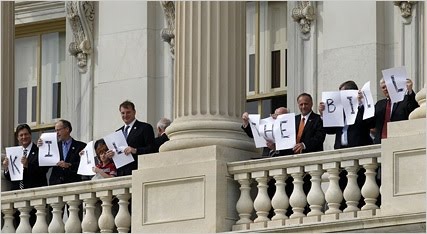
Not so for the Republicans, who were not at all inclined to send Nancy Pelosi roses. Instead they were promoting a viral video of her face, surrounded by flames, with the caption "Fire Nancy Pelosi." If this were the Middle Ages, they'd be burning her flat out at the stake. Since this is 2010, however, stuff like that happens mostly on line. Mostly, but not entirely. While votes for the bill were being counted, a few Congressional Republicans stood outside on the balcony overlooking the mall, holding letters that spelled out "Kill The Bill," egging on the hecklers and Tea Party protestors down below.

Afterwards, as Congressmen were leaving the building, protesters called John Lewis a "nigger." They called Barney Frank a "faggot." They spat on Emanuel Cleaver and Rep. Randy Neugebauer called Bart Stupak a "baby killer," because he had offered up the defining "yes" vote for the bill. "Let's beat the other side to a pulp!" Rep. Steve King, Republican of Iowa, shouted to the last of the Tea Partiers on Sunday night. "Let's chase them down! There's going to be a reckoning." These are not just isolated "fringe" elements carrying on in this manner, as is often reported. They are hard-core Republican Congressmen, who have incorporated themselves into the Tea Party movement.

Later, protestors placed a coffin on Russ Carnahan's lawn. They sent faxes of nooses to Jim Clyburn. In my state, someone tried to cut the propane gas line at Tom Perriello's house --but ended up cutting his brother's line by mistake, because a wrong address had been posted on a website. Meanwhile, ten Democratic members of Congress have had to get increased security and police protection because of threats.

All week long I found myself wanting to sing an old childhood song: "The bear went over the mountain." "The bear went over the mountain. The bear went over the mountain, and what do you think he saw? He saw another mountain, he saw another mountain, and what do you think he did? He climbed the other mountain, etc." [repeat and repeat, ad infinitum]. Democrats just got over one huge mountain, and what do you think they saw? More willful obstruction and escalating threats. Another mountain to climb.

An apopletic John McCain has now gathered up his toys and declared that he will not play with Obama anymore: "No cooperation for the rest of the year." ("This is an adolescent living in the shell of a former statesman," wrote Timothy Egan in the New York Times.) Yesterday I heard on NPR that my state of Virginia has already refused to enact any legislation with a Federal mandate that requires the purchase of health insurance. Many other states are following suit. Since Republicans failed to make health reform Obama's "Waterloo," they will now try to make it into his "Monicagate," in a further effort to tie his presidency up in knots through millions of dollars' worth of obscene law suits and wasteful legal proceedings.

Perhaps the most interesting skirmish of the week may have gone unnoticed by anyone except diehard Washington watchers like me. It involved the sacking of David Frum, a former speechwriter of George W. Bush, and, since 2003, a resident fellow at the American Enterprise Institute (AEI), a conservative think tank. Frum sealed his own fate when he wrote on his blog, FrumForum. that Republicans had suffered their own devastating Waterloo in their loss to President Obama on health reform. "It's hard to exaggerate the magnitude of the disaster," Frum lamented. "We followed the most radical voices in the party and the movement, and they led us to abject and irreversible defeat." The Institute's donors were not happy with Frum's comments. Frum was given his walking papers by AEI President Arthur Brooks.

I append a few reader responses that I found on the net to these various events:

"I have to say that I do believe all of this agitation will lead to a tragedy. I hope it's one that the nation can survive. But the Republicans seem to have decided that they will not give up the right to govern, no matter how much they lose elections. They are willing at this point to use increasingly graphic forms of intimidation. I hope the FBI is taking note." Jane Smiley

"Unfortunately the obstinacy of the Republican party is not funny or cute. It is dangerous and anti-American, however much they drape red, white and blue and a fraudulent "Christianity" over themselves. Following the ugly "tea party" prior to the vote, and the physical attacks and threats after the vote, it is clear that the Republican party is encouraging such actions.
Obama should make an address, informing these people that they live in a democracy, majority vote wins, and any incitement or actual taking of violence will be dealt with by the law - whether coming from the mouths of Limbaugh, Beck or a foaming tea-partier on the street. If nothing is done we can anticipate shortly assassinations and jack-boots.
Not so funny." Jon Jost Seoul, Korea

"When is the story ever going to be about the total obstruction of the Republicans? They apparently care nothing about the people of this country. Of course, since they don't believe in government, they don't care if it works. I will never understand why we elect people to Congress who do not believe in government. This makes no sense." Elin Carrington, ND

In case you are wondering why I write about these matters so obsessively, it is because one day, when the bear climbs over the mountain, it may find, not another mountain, but something truly monstrous. People will wonder how this could possibly have happened in our country? At which point the story, the one that hasn't happened yet, will have already been chronicalled here.

Monday, March 22, 2010

Six Impossible Things Before Breakfast


Sometimes, as old Gertie Stein might have observed were she still alive on planet Earth, a great day is a great day is a great day (roses notwithstanding). Which is to say only that, every once in a while and even if you are not exactly living in Alice's Wonderland, six impossible things can still happen before breakfast:

1. "We rose above the weight of our politics. We proved we are still a people capable of doing big things." [Barack Obama] After a year of dismal Congressional wrangling and intractable Washington gridlock, Democrats broke out of their trance and passed health care reform. Two months ago this bill was deemed as good as dead.

2. The President, flailing badly in the polls, got his groove back.
He took risks, he led, he won--as in, he came, he saw, he conquered. "Regardless of whether the health care bill survives, Obama has demonstrated that he can. And if the reform bill passes, and his numbers rebound, I'm going to take to calling him Barack the Unbreakable." [Charles Blow, a columnist who has been taking Obama to the mat repeatedly in the New York Times]

"All year, his party has been begging him to drop health care and do something about jobs...[but] he stuck to his guns. Speech after speech, phone call after call, sit-down with one frightened or greedy or confused legislator after another, he kept on the case. 'Do not quit. Do not give up,' he told yet another rally on Friday. 'We are going to get this done.'" [Gail Collins, also in the New York Times]

"Whatever you believe about health care reform, it's hard to escape the conclusion that for one party, opposing reform was expedient, and for another, supporting it required the summoning of an uncommon degree of bravery and a resistance to every base political instinct. Obama is uniquely courageous...All the more so if you oppose the legislation. If you think it will break the part of the health care system that works, if you think it will bankrupt the country down the road. You ought to be might frustrated by Obama's courage, blind as you believe it might be. But don't ever, ever call the guy a wimp." [Marc Ambinder, theatlantic.com]

"He still wants to rebuild the American economy from the ground up, re-regulate Wall Street, withdraw from Iraq, win in Afghanistan, get universal health insurance and achieve a two-state solution in Israel/Palestine in his first term. That’s all. And although you can see many small failures on the way, and agonising slowness as well, you can also see he hasn’t dropped his determination to achieve it all." [Andrew Sullivan]

3. America got its soul back.
Despite a year's worth of lies and misinformation, racist hatred and demagoguery, the politics of fear struck out and our better angels won. "I want you to consider the contrast: on one side, the closing argument was an appeal to our better angels, urging politicians to do what is right, even if it hurts their careers; on the other side, callous cynicism...that has been the hallmark of the whole campaign against reform....The emotional core of opposition to reform was blatant fear-mongering, unconstrained either by the facts or by any sense of decency...Without question, the campaign of fear was effective: health reform went from being highly popular to wide disapproval...But the question was, would it actually be enough to block reform? And the answer is no...This is, of course, a political victory for president Obama, and a triumph for Nancy Pelosi, the House speaker. But it is also a victory for America's soul. In the end, a vicious, unprincipled fear offensive failed to block reform. This time, fear struck out. [Paul Krugman]

4. Despite their vicious opposition to the bill, Republicans will still be covered in their time of need.
"So, when you find yourself suddenly broadsided by a life-threatening illness someday, perhaps you'll thank those those pinko-socialist, Canadian-loving Democrats and independents for what they did on Saturday evening...Please, my Republican friends, if you can, take a quiet moment away from your AM radio and cable news network this morning and be happy for your country. We're doing better. And we're doing it for you, too." [Michael Moore in a letter to Republicans on the Huffington Posr]

5. A historic restructuring of the nation's health care system that has eluded Obama's predecessors for more than a century has finally occurred.Health insurance companies will no longer be allowed to deny people coverage because of preexisting conditions—or to drop coverage when people become sick.
" 'The noise! And the crowds!' said an officer trying to describe Dunkirk without having found his objective correlative." [Ernest Hemingway]

6. And here's the sixth impossible thing: I'm pumped! Happy at last.
With my chauffeur, limosine, and forty trunks, I'm off to see the Wizard. The Wonderful Wizard of Oz--an old buddy of Virgil's, bootlegger, and folk hero of a nation. It's a good time to get out of town, because Republicans, whose moms never taught them to be good losers, are more PISSY than ever. Having bet the store on throwing everything into killing the bill, thinking that it would result in its defeat, they are not happy campers:

Reax: The Right
Boehner: "We have failed to listen to America."
McConnell: "It marks the beginning of a backlash against Democrats in Washington who lost their way."
McCain: "The American people are very angry. They don't like it and we're going to repeal this.''
Steele: "Today, America witnessed the first vote for the end of representative government."
National Review: "Congress has narrowly passed a bill that simultaneously undermines life, liberty, and the pursuit of happiness."
Frum: "Republicans today suffered their most crushing legislative defeat since the 1960s."
[Mark Halperin, thepage.time.com]
Rush Limbaugh [on AM radio earlier today]: "We have to get rid of these bastards. We need to wipe them out."
Does this scare YOU?

Wednesday, March 17, 2010

A Portrait of the Master Saboteur-in-Chief


He looks exactly like that dentist whose cuff buttons are made of human molars. I never could stand the pompous, puffed-up, squirrelly cheeks--or the grotesque pack of lies he stores in them as if they were acorns. So I was happy to see an article on the front page in today's New York Times that finally "outted" the Republican minority leader, Mitch McConnell, as the guy who has masterminded and orchestrated the plot to basically throw Obama and Congressional Democrats down the stairs.

I know, I know. Enough already! I'm starting to sound like one of those crazy kooks who used to stand on soapboxes in Speakers Corner in London (do they still do that, I wonder?), but I just can't seem to get over how irrevocably the whole anarchic, dishonorable, Republican circus is propelling our democracy into rack and ruin. I can't continue to watch this happening and just remain mute: I have to howl. Because I'm horrified. Maybe I need to be taken outside the house and walked.

How can it be, I wonder, that Bill Clinton was all but IMPEACHED for getting a blow job in the Oval Office, but a diabolical, potentially treasonous man--and a plan like this--gets a pass? It's not like any of this is hidden. It is not a matter of speculation, or biased interpretation, at this point. It's a matter of pride: Republicans believe this is their Renaissance. Giving off ripples of bright triumph, they couldn't be more proud of their radioactive, bone-eroding accomplishment. Read this. You will find a truly vile vignette for our truly vile political times.

Senate G.O.P. Leader Finds Weapon in Party Unity

By CARL HULSE and ADAM NAGOURNEY

WASHINGTON — Before the health care fight, before the economic stimulus package, before President Obama even took office, Senator Mitch McConnell, the Republican minority leader, had a strategy for his party: use his extensive knowledge of Senate procedure to slow things down, take advantage of the difficulties Democrats would have in governing and deny Democrats any Republican support on big legislation.

Republicans embraced it. Democrats denounced it as rank obstructionism. Either way, it has led the two parties, as much as any other factor, to where they are right now. Republicans are monolithically against the health care legislation, leaving the president and his party executing parliamentary back flips to get it passed, conservatives revived, liberals wondering what happened.

In the process, Mr. McConnell, 68, a Kentuckian more at home plotting tactics in the cloakroom than writing legislation in a committee room or exhorting crowds on the campaign trail, has come to embody a kind of oppositional politics that critics say has left voters cynical about Washington, the Senate all but dysfunctional and the Republican Party without a positive agenda or message.

But in the short run at least, his approach has worked. For more than a year, he pleaded and cajoled to keep his caucus in line. He deployed poll data. He warned against the lure of the short-term attention to be gained by going bipartisan, and linked Republican gains in November to showing voters they could hold the line against big government.

On the major issues — not just health care, but financial regulation and the economic stimulus package, among others — Mr. McConnell has held Republican defections to somewhere between minimal and nonexistent, allowing him to slow the Democratic agenda if not defeat aspects of it. He has helped energize the Republican base, expose divisions among Democrats and turn the health care fight into a test of the Democrats’ ability to govern.

“It was absolutely critical that everybody be together because if the proponents of the bill were able to say it was bipartisan, it tended to convey to the public that this is O.K., they must have figured it out,” Mr. McConnell said about the health legislation in an interview, suggesting that even minimal Republican support could sway the public. “It’s either bipartisan or it isn’t.”

Mr. McConnell said the unity was essential in dealing with Democrats on “things like the budget, national security and then ultimately, obviously, health care.”

Still, he said, his party had offered Democrats a chance for a deal on health care but blamed them as being inflexible. Democrats and the White House heavily courted Senator Olympia J. Snowe, Republican of Maine, who voted for an early version of the bill but later broke with Democrats. Democratic leaders, including the majority leader, Harry Reid of Nevada, said they did not think Republicans were ever serious about trying to strike a deal.

The extent of Republican unity to date is attributable to some degree to Democratic missteps, as well as to the rise of the Tea Party movement, which has exerted tremendous pressure on Republicans not to do anything that might give comfort to the president and his party.

But it is also testimony to how Mr. McConnell has been able to draw on 25 years of Congressional savvy to display a mastery of legislative maneuvering. Mr. McConnell rejected the criticism that his approach is all about scoring political points by denying Mr. Obama any victories. His opposition, he said, is rooted in a principled belief that Mr. Obama is pushing the nation in the wrong direction.

* * *

“Their goal,” said Senator Richard J. Durbin of Illinois, the Democratic whip, “is to slow down activity to stop legislation from passing in the belief that this will embolden conservatives in the next election and will deny the president a record of accomplishment.”

“Senator McConnell is their inspiration, their enforcer and their enabler,” Mr. Durbin said.

Yet such critiques do not disturb Mr. McConnell, who has for years been raked over the editorial coals around the country for his signature opposition to campaign finance law changes. On the wall of his private Senate office, where most lawmakers hang photographs of themselves with presidents and dignitaries, Mr. McConnell instead has framed originals of venomous editorial cartoons that portray him in most unflattering terms.

The strategy that has brought Senate Republicans where they are today began when they gathered, beaten and dispirited, at the Library of Congress two weeks before Mr. Obama’s inauguration. They had lost seven seats in November, another was teetering, and they were about to go up against an extraordinarily popular new president and an emboldened Democratic Congress.

“We came in shellshocked,” said Senator Lindsey Graham of South Carolina. “There was sort of a feeling of ‘every man for himself.’ Mitch early on in this session came up with a game plan to make us relevant with 40 people. He said if we didn’t stick together on big things, we wouldn’t be relevant.”

As the year went on, Mr. McConnell spent hours listening to the worries and ideas of Republicans, urging them not to be seduced by the attention-grabbing possibilities of cutting a bipartisan deal. “I think the reason my members are feeling really good,” he said, “is they believe that the reward for playing team ball this year was the reversal of the political environment and the possibility that we will have a bigger team next year.”

On the first big test of his strategy, Senate passage of the economic stimulus bill, Mr. McConnell lost three Republicans; one of them, Senator Arlen Specter of Pennsylvania, would soon leave the party. Yet before long, Republicans in both houses had become a monolith of opposition.

***

“Good politics is repetition,” Mr. McConnell said. When there were signs of Republicans breaking from the ranks — like when Senator Charles E. Grassley of Iowa led a delegation of Republicans in negotiations with Democrats about a deal on health care — Mr. McConnell would keep close watch.

***

As the months went on, Mr. McConnell would show up at weekly meetings of his conference with a chart tracking poll numbers that, by summertime, showed that support for a health care overhaul had flipped. With their approach producing tangible benefits, Republicans were driven even more strongly to remain united.

Just before the summer recess, on July 21, Mr. McConnell used the weekly luncheon of Senate Republicans in the L.B.J. Room off the Senate floor to list the fruits of their labor. His PowerPoint presentation showed that the president’s approval rating was down and that Republicans were gaining on Democrats on the question of which party voters would prefer to see controlling Congress. “We came up with a plan, stuck to it, and now we’re starting to see results,” the presentation noted....In meeting after meeting in the Capitol, Mr. McConnell, a devoted fan of University of Louisville basketball, urged his colleagues to keep playing “team ball.” He reiterated the message he had employed for a year — the party’s resurgence depended on unity, and Republicans needed to be patient.

They listened. By the time the health bill was approved by the Senate on Christmas Eve with zero Republican votes, Democrats had been forced to cut questionable intraparty deals and jump through legislative hoops in an ugly process that helped sour the public on the party and its legislation.

Saturday, March 13, 2010

Fearless Politics/Fearless Art


"What do you think of Obama NOW?" The question was casually tossed at me from a guy in my exercise class who has been absent for the past six months or so. Previously, during the long election campaign, we would occasionally share enthusiastic assessments of the future President. But I could tell from the tone and phrasing of his current comment that he had joined the now-bulging ranks of People Who No Longer Support Obama. His main complaint? Obama should have given up on those Republicans a long time ago. He's too quick to compromise, and hasn't shown enough moxie. It seems we've heard that tune before.

I went up to him again after class, feeling a need to set the record straight. Bailing on the Republicans, turning his back on them, I told him, would play straight into their hands, and is exactly the victory they are waiting for--the chance to blame their own extreme partisanship on him and thus co-opt the story. (See how he absolutely refuses to work with us?)

In one of his town hall meetings this week to promote the health-care bill, Obama said, "They think they're wearing me down. But I'll wear them down long before that." Even David Brooks admitted to being awed by Obama's display of "tremendous tenacity."

The President, in my view, has shown an uncanny ability to evolve in the face of incredible stress and obstruction, and never let the bad wipe him out. Where you and I would have snapped long ago--become defeated, frustrated, or offended by the onslaught of undeserved, unfair attacks he has endured--Obama remains in the mode of non-reaction; his ego doesn't react, and it seems to drive people crazy. It's a martial ability his detractors simply can't fathom: defusing and deflecting the aggression of others by relaxing into it, instead of pushing back with force. The discipline of relaxation and non-action goes against all their programming.

There is only one way to relax, yield, and become soft when confronting the hard force of attack, and that is to surrender all fear. After a year in public office with lots of opportunity to practice, Obama has lost his fear. While Republicans grow ever more psychologically stiff and aggressive, the President, by contrast, has become more supple and strong. Instead of pushing back on their brittle false fronts and body armor, he has learned to absorb whatever strikes him, not blocking or shoving back but staying soft like a piece of cloth so an attack will have no point on which to exert its force. The secret is not to resist or insist, but to become instead even more resilient. Obama understands, in the words of author Joshua Cooper Ramo, that "The snapped ruler remains snapped forever." So he never snaps.

I'm probably going to overfish my pond here with where I'm going next, and the comparison I'm about to make. I think Obama has a female counterpart in the art world, who just happens to be my favorite artist ever. Her name is Marina Abramovic, and a retrospective of her work opened this week at the Museum of Modern Art in New York. For thirty years Abramovic has practiced a unique kind of performance art she helped to pioneer, sometimes known as "Ordealism." Now 63, she is still beautiful, and a photograph of her in a recent New Yorker portrays her enacting one variation in a series entitled "Dragon Heads," which for me has always been the most compelling of all her works.

In the photo, Abramovic sits mutely like a rock full of iron, with a python draped around the crown of her head. The snake dips down blocking one eye, extending itself beyond the bridge of her nose and below her mouth, its head brushing against her chin. Another python is curled around her neck, its body knotted like a scarf. The image is unbelievably stunning. You see a variation of the same work in the photo above, taken during a performance at the Museum of Modern Art in Oxford. Abramovic sits in a chair while pythons and a boa constrictor crawl over her body. She has to remain utterly passive and non-reactive. The snakes will respond to any excess energy or show of fear, and she could die. All her works require a similar ability to control the energy flow in her body, to relax and surrender her fear.

To me, it is not too freakish or too far-fetched to place Obama's political trials of endurance with Republicans along the same spectrum of mastery as Abramovic's extraordinary artistic ordeals with snakes. Both require embracing challenging situations, and using them as entry points into the mode of non-reaction by stripping away the limits imposed by fear. Both involve looking for the trail to the dangerous edge and then climbing it.

So now, call me crazy, but whenever I picture Obama hard at work in his office in the White House, it is always with snakes draped over his body. The door is open. Let's dance, he says, bringing out his flute.

Friday, March 5, 2010

Vicious-Circle Politics


It was interesting to hear Indiana Senator Evan Bayh talk to Charlie Rose about his decision to not run again. As a former governor, Bayh explained, he actually got to govern on a daily basis--to get things done, make decisions, and make a difference. In Congress, not so much. Bayh had previously said elsewhere that he'd rather have a root canal than work there--but he did have dazzling things to say about Obama, and what a fantastic president he is.

Congress was definitely under the gun this past week. It's gridlocked failure to function was the lament and refrain on all the talk shows, the topic having been kicked off by a cover story in Time magazine that posed the question "why is Washington tied up in knots?" I found Peter Beinart's answer the most enlightening. Beinart unwinds the current extreme polarization in American politics by tracing its history over several decades, putting into plain English exactly why discontent with government is now at its highest levels ever.

He shows that this is not, by any means, a brand new story. Partisan divides have always been there: we can trace their progression. Back in 1856, for instance, a South Carolina congressman beat a Massachusetts Senator half to death in the Senate Chamber and received dozens of new canes from fans. (Today he would receive millions of campaign dollars on his website over night.)

Polarization in politics, as Beinart (a senior fellow at the New America Foundation and author of a forthcoming book that sounds really interesting, "The Icarus Syndrome: A History of American Hubris") explains, has always been part of the American narrative, but even so, it used to be routine to cross party lines in Washington to resolve disputes. Not any more. These days, party discipline is maintained by Republicans to the point where any cooperation with Democrats or any show of bipartisanship is deemed treasonous to the larger goal of "stopping Obama in his tracks." The constant threat to retract party support and withdraw financial backing for future campaigns, along with threats to run a more conservative GOP candidate instead, are the methods used to intimidate members into maintaining lockstep conformity within the party. If they don't conform, their photos are removed from the wall at the offices of the Republican Senate Campaign Committee. In short, they get ex-communicated.

Beinart believes that serious, non-negotiable, partisan divide first began to show itself over civil rights, abortion rights, and environmental issues during the presidencies of Ronald Reagan and George H.W. Bush, but it wasn't until the Clinton era that congressional Republicans realized they could use political polarization to actually stymie government--and then use government failure to win elections. Under Clinton, when the GOP no longer controlled the White House, "a new breed of aggressive Republicans (Newt Gingrich, Tom DeLay, Trent Lott) raised their strategy for discrediting both the President and government itself to an art form. They learned the secrets of what Beinart aptly calls "vicious-circle politics:"

Vicious-circle politics works like this: above all, keep anything from getting done. When nothing gets done, people turn against government. When you're the party out of power and the party that reviles government, you win. Republicans have used this rising disgust with government to cripple health-care reform in the hopes of derailing all subsequent Obama initiatives. At its core, vicious-circle politics isn't an assault on liberal solutions to hard problems, says Beinart. It is an assault on any solutions to hard problems. God help us.

Something has to end the stalemate. I often wonder why Democrats don't talk more about the impossibility of governing when the opposition is committed to "no" as a bloc. I personally think Democrats in Congress should walk around with Jim DeMint's statement "If we're able to stop Obama on health care it will be his Waterloo. It will break him" inscribed on their palms, a la Sarah Palin. That way, maybe they would remember to repeat the comment over and over again, out loud, every time a media interviewer wants to know what's wrong with Washington. But this is not Obama's way. Obama believes you catch more flies with honey than you can with vinegar. So he continues to reach out to the GOP on the health-care bill, even though he knows it is a lost cause.

In his most recent letter to congressional leaders, he offered to include four GOP ideas (medical malpractice pilot programs, expanding HSAs, cracking down on fraud, and increasing Medicaid payments to doctors). But Republican leaders predictably dismissed the offer: “There is no reason to lump sensible proposals into a fundamentally flawed 2,000-page bill,” John Boehner said. These disingenuous popinjays, behaving like parrots on a pole, never pass up an opportunity to not oblige. This is not merely a philosophical difference; it is a political calculation. Meanwhile Obama has vowed to press on with reform: both parties “should agree that it's just not an option to walk away from the millions of American families and business owners counting on reform."

The President's last and final overture having fallen yet again on dead ears, he is now proceeding to launch the "final push" for legislation on his own, making the case for giving up on the GOP and moving on to passage without them. Fundamentally, he argues on policy grounds, the Republicans don't have a practical plan for expanding and improving coverage. These are his arguments:

"Now, despite all that we agree on and all the Republican ideas we’ve incorporated, many Republicans in Congress just have a fundamental disagreement over whether we should have more or less oversight of insurance companies. And if they truly believe that less regulation would lead to higher quality, more affordable health insurance, then they should vote against the proposal I’ve put forward.

Some also believe that we should instead pursue a piecemeal approach to health insurance reform, where we just tinker around the edges of this challenge for the next few years. Even those who acknowledge the problem of the uninsured say that we can’t afford to help them – which is why the Republican proposal only covers three million uninsured Americans while we cover over 31 million. But the problem with that approach is that unless everyone has access to affordable coverage, you can’t prevent insurance companies from denying coverage based on pre-existing conditions; you can’t limit the amount families are forced to pay out of their own pockets; and you don’t do anything about the fact that taxpayers end up subsidizing the uninsured when they’re forced to go to the Emergency Room for care. The fact is, health reform only works if you take care of all these problems at once.

Both during and after last week’s summit, Republicans in Congress insisted that the only acceptable course on health care reform is to start over. But given these honest and substantial differences between the parties about the need to regulate the insurance industry and the need to help millions of middle-class families get insurance, I do not see how another year of negotiations would help. Moreover, the insurance companies aren’t starting over. They are continuing to raise premiums and deny coverage as we speak. For us to start over now could simply lead to delay that could last for another decade or even more. The American people, and the U.S. economy, just can’t wait that long." (Hat tip: Ben Smith/Politico.com)

Hopefully, Obama's perseverance, tenacity, and unflagging efforts will win the day. Maybe he can still swim through fire and water to the bitter end--where actual accomplishment will succeed in "de-spookifying" the weird messages in which Republicans have marinated this bill. By refusing to cooperate with Obama, and then accusing him of partisanship, they plan to kill off all his initiatives, and brand him as ineffective. Prevent improvement in people's lives, and then point out that their lives are still unimproved. To break this cycle Republicans have set in motion, health-care reform absolutely must pass--or America will become the total forever slave of successful vicious-circle politics. Having made a pact with the devil, these Faustian men will not stop until they have bashed the bushes, gagged the rocks, and drained all flow of meaning right off the planet.

Monday, February 22, 2010

A Ghoulish Populism


"How's that hope-y, change-y thing workin' for ya?" This was Tea Party icon Sarah Palin a couple of weeks ago, always devout but ever so subtly vicious, stoking her fan base at the first official Tea Party Convention in Nashville--people who came from all over America to watch the media superstar dispense her "pitch-perfect populism" aimed at leading the GOP to political El Dorado. Interviewed shortly afterwards by Chris Wallace of Fox News, Palin was asked what her approach to foreign policy would be if she were elected president. "That's easy," she replied. "We win, you lose." Now you tell me, how irresistible is that? Andrew Sullivan, who live-blogged the entire 40-minute speech, had this to say afterward: "If you are one of those people who think this person cannot become president of the United States, think again."

Republicans, according to Frank Rich in the New York Times, have fully embraced what he calls "the Palin shtick," namely, the notion that Republicans are the anti-big-government, anti-stimulus, anti-Wall Street, pro-Tea Party tribunes of the common folk. It's all part of the new "populist putsch" by which the GOP is rebranding itself as anti-Washington and linking Democrats to corporate interests. "This GOP populism is all bunk," Rich writes, "but they're getting away with their 'Populist masquerade.'"

Reading the words "Populist masquerade," I couldn't help thinking of that once-revered puppet team, Punch and Judy. Sarah Palin is indisputably the GOP's Judy, but who among the vast mishmash of ill-assorted and ill-equipped male candidates, is destined to become her Punch? Republicans all know there is a glaring vacuum here, and last week at the annual Conservative Political Action Conference (famously known as CPAC), they were desperately trying to fill it, using this year's event as more of a nominating process to flush out the Party's leading lights.

Conspicuously absent from the CPAC proceedings were Sarah and Rush, but the rest of the GOP crowd who (rather like the Taliban in Afghanistan and al-Shabat in Somalia) would like to topple the government and gain control of the nation, were out in full force. As I followed a live-blogging account of the 3-day conference on HP and saw excerpts from some of the speeches on TV, Punch and Judy slowly morphed into something much bigger: Grand Guignol. This was literally the Theater of the Big Puppet, which existed in Paris in Place Pigalle from 1897 to 1962, and specialized in naturalistic horror shows.

The term is still used for graphic, amoral horror entertainment, a genre first popular in Elizabethan and Jacobean theater. And when I discovered the above photo on the Internet--of Grand Guignol actors in a production demonstrating the "face-frying technique"--I knew I had hit pay dirt. The image meshed perfectly with CPAC's "stomping carpet," which was embedded with the faces of MSNBC pundits like Keith Olbermann, along with an invitation to "stomp on me."

Of course, the face really being fried and stomped on at CPAC's destruction derby was that of Barack Obama.
Mitt Romney kicked off by calling Obama's presidency a failure. John Boehner complained that Obama had slapped the table and wagged his finger at him during a White House meeting, ostensibly for scaring the American public into a state of economic anxiety. Tim Pawlenty suggested Republicans take a cue from Tiger Woods' wife and use a 9-iron to smash the window of big government in this country. Dick Cheney, who appeared unannounced and received a standing ovation, stated officiously that Obama was a one-term president, while his daughter Liz declared that "There is no polite way to put this: Obama's incompetence is getting people killed." For three days the place was rife with toxic hypocrisy, caustic ignorance, and the determination to do damage to Obama--all under the guise of being saviors to working-class Americans. One could only conclude that Conservatives, with their amoral melodramas, unpredictable manias, and macabre ironies, are true heirs to the golden age of Grand Guignol and its nihilistic universe where there is retribution but no justice.

So, in this crazed and sinister production with all the stops out, which conquistador emerges as the front-runner, the penultimate Punch? Answer: Ron Paul. If you don't believe me, check out the Straw Poll stats below:

Ron Paul wins CPAC 2010 straw poll.
Romney makes a healthy second, way ahead of the rest of the pack.
Results:
Ron Paul 31%
Mitt Romney 22%
Sarah Palin 7%
Tim Pawlenty 6%
Mike Pence 5%
Newt Gingrich 4%
Mike Huckabee 4%
Mitch Daniels 2%
John Thune 2%
Rick Santorum 2%
Haley Barbour 1%

AAnd if you want to leave the Theater of Horrors feeling good about what you've just seen, consider the reassuring thoughts of Atlantic blogger Marc Ambinder, who captures the contradictions these folks are managing to produce in the mass psyche as they busy themselves turning our world inside out:

"As the political world tries to make sense of the cartography of the Republican Party -- where does Ron Paul fit in? Is CPAC too libertarian? Does Mitt Romney speak the language of the conservative base? How does CPAC relate to the Tea Party movement? How do Ron Paul and Sarah Palin relate to the Tea partiers? How does the Republican primary base intersect with -- or does it -- with the Tea Party movement -- and what does this augur for 2010 --?"

Monday, February 15, 2010

Winter Blues & the Perfume of Orchids

For the time being, my sunny, talking alligator and blogging assistant, Virgil, has deserted me--having fled, no doubt, to warmer climes somewhere in the land of water moccassins, canoes, and murky swamp waters. As for me, I'm still channeling Nanook, here in the Virginia tundra. I was pleasantly stopped in my tracks this week by a midget snow poem written by Robert Bly, published in a recent New Yorker:

SUNDAY AFTERNOON

The snow is falling, and the world is calm.
The flakes are light, but they cool the world
As they fall, and add to the calmness of the house.
It's Sunday afternoon. I am reading
Longinus while the Sugar Bowl is on.
The snow is falling, and the world is calm.

Much as I love Robert Bly's poetry, I couldn't find myself anywhere in this poem, peacefully at home, reading Longinus in a calm world. I wish I could, but I can't. There is no way I'd ever be caught reading Longinus; the snow this winter is positively demonic; and the world I live in is anything but calm. I am not calm. I shovel and worry, worry and shovel.

"You were oh so close for a minute there," writes my friend Paul Zenner in an email. "I thought Mr. Zinn may have turned you toward the light. That's okay. We'll keep throwing switches and pushing those positive buttons and sooner or later, the light will shine." Paul is a master at making me confront my own darkness--my Armageddon complex. He would like me to take the world a little less seriously, to be of faith and good cheer instead. However, to do that, I'd have to become somebody else.

I also read what David Brooks wrote in the New York Times about his experience of the recent DC blizzard and losing power. These were thoughts I could more easily relate to:

"I set out across the driveway in search of woolly mammoths to eat. Suddenly everything Keith Olbermann says started to make sense. I was down to the primitive core...And so I wonder if my general political sentiments these days are the result of my journey into the heart of coldness or something broader. To be brief, I’ve never been more depressed about Washington’s ability to do anything. I also have the feeling we’re in for a miserable period for political opiners — all that we’ll be covering is a nasty set of squabbles over small amounts of money that are not there."

Later on, I heard him say, in an hourlong interview with Charlie Rose, that he fears the country has become ungovernable. In talking with his political friends on the Hill, it was clear to him that any hope of bipartisanship is dead in the water. Belly up like a diseased seal. Brooks seems as depressed about this as I am.

New Yorker columnist Hendrik Hertzberg believes that Obama's passion for bipartisanship and commitment to the reforms he campaigned on are genuine--but that Republican rancor will not allow any legislation to pass that could be viewed as an accomplishment for him. If health care reform ends up failing, it's hard to see how they will be able to do anything else, he says. "The damage to their ability to govern--the damage to the ability of the country to govern itself--will be severe."

So here's my problem: I think these things really matter. But I don't know how to write about them without sounding alarmist--or expressing grief. I would prefer, as I've said before, to send out sweet, quenching drafts of love and light to anyone who actually bothers to read this blog, but it would be a transgression, and a falsification, of how I really feel. So I don't know what to do. Whenever I really don't know what to do, I end up consulting the I Ching.

The I Ching is suggesting, in this case, that the difficulties and obstacles within the situation are causing me much sorrow. [Check!] To break through a tough situation, it says, people need to work together in harmony, as in an alliance. [Listen up, hear ye, calling all Republicans.] Seeking harmony begins with crying and weeping, but ends with laughing. The great multitude succeeds in meeting--and after great struggles (the I Ching proposes), they succeed in meeting and celebrate the victory. [Can you even imagine it? Some positive legislation is passed, and everyone celebrates the victory?]

An old Chinese axiom states that "people in the same boat help each other, sharing weal and woe." Seeking harmony, with government serving the common interest--yes, the I Ching really does say this, I am not making it up--turns out that this was something the ancient Chinese dreamed of day and night.

In the matter of whether it is okay to write when you are feeling down, my hexagram [Fellowship with Men] counsels that if I openly express my distress, I will find that it generates similar expressions from my fellow man. Then together we can overcome the difficult time and there will be much joy in the newfound unity. So it is decided: I will continue to "openly express my distress," and stop worrying about whether its having a bad effect or adding to the world's already overstocked misery.

Confucius once said:

Whether in charge of a government or being a hermit,
Or keeping quiet or making a comment,
When two people become one in their hearts
They are as sharp as a knife that is able to cut iron.
They cherish the same idea and follow the same path;
Their words are like the perfume and fragrance of orchids.

She studies the wall as if planning to hang something cheery, maybe some Monet haystacks or even orchids. At the edge, one final row of lavender azaleas. (She is still wearing her sunglasses and hospital pajamas.) Outside, in the randomly broken world, it begins to snow again. She bends over to inhale the perfume of orchids now infused with her own words.