Tuesday, May 18, 2010

The Orange Alligator (3)


The trouble with obsessing over collapse," Bill McKibben writes in the second half of "Eaarth: Making a Life on a Tough New Planet," "Is that it keeps you from considering other possibilities." He was chiding writers like Jim Kunstler and Jared Diamond, dubbed as "doomers" or "dystopians" in a recent New Yorker article, whose writing McKibben classifies as "collapse porn." "Collapse," he writes, "can become as much of an ideological fixation as growth." It's something I've been concerned with myself, when I write here. But that was before the oil starting gushing uncontrollably in the Gulf. Computer models are now showing the oil is dangerously close to the loop current which would carry it into the Atlantic Ocean.

We're not entirely out of possibilities, McKibben suggests in his book. But when the engines start to fail, we have to stop being progress junkies, trying to fly the plane higher. Instead we need to learn to manage our descent and aim for a relatively graceful decline. "From now on," he argues, "we're about KEEPING what we've got. MAINTENANCE is our mantra." We need stability and security more than we need dynamism and growth and progress and speed. Those times are over. We need to understand that we are a country that has a chronic disease that slows us down, a country being sapped by global warming and the end of oil and a flailing economy. We need to not squander what we have.

Not squandering what we have becomes a surreal injunction as we hemorrhage precious oil reserves, while simultaneously suffocating the sea and its inhabitants. This is surely a double whammy, and it may well be the case that there's no way we can actually withstand it. McKibben's book, only a few weeks ago, seemed like a massive leap away from the notion of "future threat" into a more immediate reality. In light of the events transpiring in the Gulf, that leap may already be obsolete.

My good friend Bob Walker recently forwarded some thoughts to me that he had just written to someone else, a friend who was stressing over the latest Supreme Court nomination charade. Bob wrote him back: "All this is much ado about nothing. The real crisis is ongoing in the Gulf of Mexico, and could prove to be an extinction level event. There are reports this morning that the BP/TransOcean/Haliburton oil spill is orders of magnitude greater than anyone first admitted. The reservoir beneath DeepWaterHorizon has been described as “colossal.” That is precisely why BP chose that spot on which to drill. A prominent US geologist said that at the present rate of discharge, the spill "would take years to deplete." That merits repeating: The spill could continue for years. Matthew Simmons, retired chair of the energy-industry investment bank Simmons & Company, said that BP and the US military's engineers are more or less clueless about cutting off the flow.”

Last weekend I had my monthly salon gathering, and everyone arrived in a jolly mood, in what seemed like a happy place--as if all was well with the world. I had determined beforehand not to bring up the subject of the oil spill--unless someone else introduced it first. Nobody did. In the end, I basked instead in the feeling of normalcy and human conviviality. I was able somehow in that atmosphere to cross back over from the far side of the looking glass and reclaim my membership in the human race, only because other people had not been as laid low by all this as me. They didn't especially realize it, but they actually rescued me from Hades, a kidnapped Persephone, and released me, with their focus on other things. I definitely don't want to go back to the underworld. It was a teaching moment: I saw that avoidance, even of potential death, can be instead the embrace of life. Avoidance does not necessarily mean careless indifference.

So I will in future follow the counsel of the I Ching, to remain gently aware that the mood [in this case, the threat to survival of life on this planet] is definitely there, and to simply watch it as one might watch a fish in the tank. "While we are not able to get rid of the mood immediately, such means enable us to keep it from getting out of hand during critical moments."

If massive suffering is truly what is on the cards for us,, then at least there is one consolation: it hasn't happened yet. In the meantime, the I Ching advises that "the time calls for self -discipline, not self-pity."

Thursday, May 13, 2010

The Orange Alligator (2)


In response to my last blog, I received an email from my friend Bill Rutherfoord, noting that the orange color of the alligator offering is just the right industrial color for this hazardous moment [of the Gulf oil spill]: he is safety orange. He then went on to say he thinks most people intuit that the enormity of the problem exceeds our technological expertise, as well as our feeble, lying morality. We need help.

This has been my terror from the start--that BP et al. won't be able to fix this. However, saying that out loud, or even thinking it quietly to myself, does not help anything. Which is probably why, last weekend, I was feeling kind of crazy and still am, jittery like those animals who sense the oncoming arrival of a tsunami before it arrives, and become agitated. E-mailing back and forth with Bill, I described some of these feelings to him. How, in my previous dabblings in possible 2012 scenarios [for end times], there was never a specific picture, just intuitions of large, deadly trends all converging. As long as there wasn't a specific picture, the whole thing remained somehow abstract, a surmise. I could bet against myself, hoping that I might be wrong: 2012 was just a nutty Mayan scenario that had been updated for our time. It was not necessarily true.

Unfortunately, the oil spill has brought with it a devastating picture of how the end could happen: seas inexorably fill up with oil. The thought struck with the force of lightning. "I have great faith in American ingenuity," said my Australian friend, Simone Paterson, trying her best to reassure me. "They'll get it fixed, Sooz. If they could put a man on the moon, they can do this." Somehow it seems as if the future of everything now depends on which one of us turns out to be right.

"We have rigged our own oceans, submerged our own futures, suffocated our own progeny, and slide now to our slick destiny. To whom can I cry that twisting off the caps of my beautiful tubes of color I now think of OIL PAINTS as the first two words of a disaster headline?" wrote my painter friend, Jane Vance.

Right now it is hard for me to speak with other people, hard to act like everything is A-okay, business as usual. I feel like Alice, having stepped through the looking glass into a parallel reality. To talk about how I really feel is likely to either wig someone out, or cause them to recoil at what they take to be my exaggerated craziness. Neither seems a good idea. I was put on notice by an old high school friend with whom I reconnected a few years ago. She retired recently from school teaching, and has thrown herself passionately into becoming a poet, taking workshops, master classes, competing for prizes. I sent her the first "Orange Alligator" blog attached to a normal email.

"As for the world," she wrote me back, "would you believe, I've stopped watching The News Hour, just glance or scan through The Times, daily, and catch an occasional NPR bit of news, unlike the way I used to be. I don't know if it's reading and writing poetry that has me so detached from the world, or what. I haven't even read any novels in months, which is also not like me. Oh, well." She didn't mention the blog. She sounded really blissful, if oblivious, while back at home here, I am feeling more and more like Anne Frank, doing the diary thing, while waiting to see if the dreaded Nazis will actually show up. I don't want to destroy other people's happiness or peace of mind. But I am struggling with trying to integrate levels of fear and grief such as I have never known before.

"I'm on my way to bed," Bill wrote me again later, "but suffice it to say that your strong feelings are not irrational. Your inclination to withhold the extent of your anxiety about the state of the world when dealing with seemingly oblivious people is just right...There is an immense learning curve that most people will remain well behind. Hang tough, and continue to watch in your own way. Conscientiously looking at the planet as it sickens is a little like [Marina] Abramovic's endurance exercise where she gazed at, and endured the gazes, of others. Watch watchman watch...The Anne Frank model strikes me as exactly right for this dangerous time, and I too am a little at odds with those who seem oblivious to the gravity of the global condition...People can't be told too much too fast, or they' dismiss it as paranoia."

Ultimately there is no way to know how this "thing" ought to be met, what responsibility any of us may bear in a crime so vast that it threatens the very future we all take for granted. In his new incarnation as agent orange, Virgil, who lives on borrowed Jewish jokiness anyway, suggests I start rubbing my shoes with butter to preserve the leather. And sit on a white cat's third eye.

A former student, Samantha Barnum, commented on the blog: "As I try to think about how to do the most good, promote maximum progress, make the best revolution, I remember that sometimes the smallest gestures can still be powerful. Like sending someone an orange alligator in the mail. It might not stop the Gulf oil leak, but it is inspiring, nonetheless. And so much better than gallows humor."

The mention of gallows humor brings Virgil back again:

How do crazy people go through the forest? They take the psychopath.
How do you get Holy Water? You boil the hell out of it.
What do Eskimos get from sitting on the ice too long? Polaroids.

Gallows humor has its place, you have to admit, especially if it's you on the gallows.

Friday, May 7, 2010

The Orange Alligator


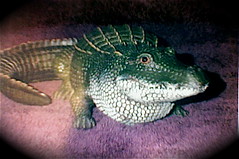
Yesterday I was the recipient of a surprise offering in the mail from a friend who lives in Black Mountain, NC: a small, orange plastic alligator. "Here is a little friend for Virgil," the message said. "Your blog is the only thing keeping me sane these days." The gift came, so to speak, out of the blue and just in the nick of time, given as how I feel anything but sane, myself, these days.

Witnessing, and then writing incessantly, about the monstrous upheavals and chronic woes of our country and of the planet (which now happen on a daily basis and are irrevocably linked) has all but eclipsed the luminous edge I would much have preferred to live by. But that hardly seems possible now. For a few seconds, it was as if the orange alligator reconstituted that lost edge, serving as a reminder, because in these dark days, my brackish soul is definitely more like that broken oil rig in the Gulf. It just keeps on gushing out raw pessimism. But with this tiny sign, the universe has somehow let me know, that in my moments of acute discouragement, someone is out there listening, and feeling helped by what I write. I can tell you, it's not easy writing about these things, because it means keeping close contact with some pretty deadly stuff.

The sight of the Grand Ole Opry stage in Nashville sitting in ten feet of river water, diesel fuel, and sewage, was not exactly a world-class cheerer-upper this week either. Nor was my mood improved by reading Jim Moore's blog on Huffington Post about the oil spill. He spoke directly to my greatest fear: we might be powerless this time to stop the oil flowing out from the seabed in the Gulf of Mexico. In fact, chances are good, he says, that we do not possess the technology, and that humans can't even function at the sea level where the leaks are, to plug them up--so robots have been enlisted to do the job. "If there is no plug placed in the hole," Moore writes, "it is not inconceivable that no part of the planet's oceans will escape harm." Just before writing this, I read breaking news that the said robots had failed in the attempt to close the leaking valve. The orange in the photo seen above is oil, slowly colonizing the sea.

Meanwhile economic reports have just come out again with small signs of positive improvement. The tone is measured as usual, but upbeat. No one mentions the spill's potential to wipe out coastal businesses around the Gulf for years to come--or its far-reaching potential to cancel out all previous, or any further, sputtering increments of the economic recovery we have managed to eke out thus far. The stock market, meanwhile, was inexplicably jittery as a cat on a hot tin roof. Nobody could say exactly why, but a commission has been formed to investigate the cause. So far at least, nobody has asked me. If they do, what I'll tell them is how really great it was to get a blazing orange alligator just as the lights went out.

Next week I will write more about the second half of Bill McKibben's book, "Eaarth: Making a Life on a Tough New Planet."

Friday, April 30, 2010

The Old Earth and the New Eaarth


According to Jungian theorist Edward Edinger, we are currently experiencing the "archetype of the Apocalypse" as a negative archetype representing the smashing of previous ways of thought and ways of being. I won't/can't deny it: these days I pretty much inhabit this archetype as a full-time denizen. The thing that continues to surprise me is that more folks don't live there, too--that others manage not to be preoccupied or obsessed as I am with the drastic meltdown of society and the accelerating prospects of environmental cataclysm.

The volcanic explosion of Eyjafjallajokull through a glacial ice cap in Iceland on April 14th, that threw a plume of ash into the atmosphere seven miles high and brought air travel to a grinding halt for nearly a week, did nothing to assuage or smoothe the feathers of my archetype. Instead, it caused a flare-up of feelings somewhere between eerie, creepy, and scary--despite the extravagant beauty of how it all looked on film. The whole airline economy seemed to hang in the balance, depending on which way the wind blew.

Our utter helplessness in the face of what was happening is stunning. Now the volcano seems, at least for the moment, to have calmed down, but this week we have a monstrous oil spill from another kind of (as yet unexplained) explosion in the Gulf of Mexico, relentlessly advancing toward the shore of Louisiana and getting worse by the minute, because no one can contain it. Now it's the fishing industry that is running scared.

Have you ever had the feeling that the universe is trying to tell you something, and you can no longer ignore its message? Have you noticed that the seas are rising and the ice is melting much faster than we once expected? This week I began reading my first climate-change book in years, just published, called "Eaarth: Making a Life on a Tough New Planet" by Bill McKibben. I bought it after seeing a review, because I had the feeling that somehow this book would be different to all the others. I have not been disappointed. From the moment he starts writing, McKibben goes full-bore into the eye-popping truth: we had our chance, he says, a brief opening to steer a different course, away from the rocks. But we didn't take it.

McKibben is a no-frills writer. There are no "feel-good" projections about an optimistic future in which we have all significantly "changed our consciousness," no hectoring about humanity's devastating failure to live sanely on the planet. There is neither bristle, nor bluster. Just this excruciating x-ray of what worldwide ecocide actually looks like:

Hurricanes have risen in frequency seventy-five percent in the last thirteen years. There have been four times as many weather-related disasters in the past thirty years, more than in the first three-quarters of the century combined. Polar ice is melting fifty years ahead of schedule. Lightning strikes in the Arctic have increased twenty-fold in 2009, igniting the first tundra fires ever observed. Tons of carbon in the form of methane are being released into the atmosphere from melting permafrost. Large forest fires now burn four times as long as a generation ago, also pumping millions of tons of carbon dioxide into the atmosphere. Oil, the very basis of our modern, techology-intensive lifestyle, is disappearing. Coal, the dirtiest of all fossil fuels, produces twice the carbon dioxide of oil and so extending its use will trigger even more global warming. The costs of environmental restoration and humanitarian disasters have become prohibitive, the insurance industry is flailing, and we can't possibly afford to repair things fast enough to preserve the planet we used to live on.

"Here's all I'm trying to say: the planet on which our civilization evolved no longer exists," McKibben writes. "The stability that produced that civilization no longer exists...We MAY, with commitment and luck, yet be able to maintain a planet that will sustain SOME KIND of civilization, but it won't be the same planet, and hence it can't be the same civilization. The earth that we knew--the only earth that we ever knew--is gone."

You can't refreeze the Arctic or restore the pH of oceans even if we all convert to solar power and bicycles this afternoon. Which we aren't doing anyway. That's not the world we live on any longer, says McKibben, and there's no use in pretending otherwise.

To read this book is to understand how all philosophical debates about whether or not climate change really exists or doesn't--whether it is a man-made calamity or just a hoax driven by politics and money--are hopelessly out-of-date. At this point, such questions are beyond mattering. The provocative events of this past month, for instance, make irrevocably clear just how much any alteration of the features of nature affects the destiny of mankind, and vice versa. Mankind's activities affect nature. It is all one big, totally enmeshed, feedback loop.

What we need to focus on is how to survive what's coming at us, because as McKibben points out, "We simply can't live on the new earth as if it were the old earth; we've just foreclosed that option." The thing to pay attention to now is that life on the new planet "Eaarth" is likely to be a lot harder for humans than on the old one. It won't be easy going, an uphill slog at best, and with considerably less time for hypothetical, pointless arguments.

Sunday, April 11, 2010

Filling in the Gaps


Last Sunday, Easter, I spent the end of the afternoon sitting outside on a friend's deck, overlooking the woods and drinking wine, eating homemade Chinese vegeterian dumplings with wooden chopsticks, and discussing politics with a perfect stranger--actually the husband of a friend of a friend, who was visiting from out of town for the weekend. The guy was a real tracker, up-to-the-minute on everything. I'll probably never see him again, and I can't even remember his name, but I sure had a blast in time and space conversing with him.

Truth is, I don't get to talk with people that often who are so engaged, informed, and open-minded, and know exactly who's who and what's what across the board. It was rather like, if you happen to enjoy tennis or chess, unexpectedly getting to play a game with somebody who's really good at it. Given the utter scuzziness of politics now, most folks are more sporadic and ho-hum about it, depending on how much else is going on in their lives.

I used to be like that myself: pretty much asleep at the switch, I have to confess, for most of my life. I am not proud of the fact that I slept right through the Vietnam war, the struggle for civil rights, McCarthyism, Watergate, presidential assassinations--you name it. Living quite happily, thank you, without all that, I was well insulated inside my own bubble. It took radical Islam flying airplanes into the World Trade Center to finally wake me up to all that was going on. Only then did I set out to master the political curriculum of government and war on the world stage, and today I have ended up swallowing it whole. Even so, I am still having to catch up with so many past years of ignorance.

What I'm saying is that there are significant gaps in what I know, some of which got some unexpected remediation this week. First, I found myself boning up, of all things, on the Holocaust, as I began to study a large catalogue about art and Auschwitz--a connection I hadn't known even existed. "The Last Expression: Art and Auschwitz," was given to me by David Mickenberg, the new director of the Taubman Museum of Art in Roanoke (and also one of the book's three editors). I didn't realize, until I started reading, that a significant body of art exists made during World War II in concentration camps.

The catalogue is huge, not least because of the ten scholarly essays it contains. It also contains reproductions of some 300 art works created primarily (but not exclusively) at Auschwitz by Jewish victims of the Holocaust. Collected and retrieved by Mickenberg (and others) for an exhibition held at the Mary and Leigh Block Museum of Art at Northwestern University in 2002, they offer an insider's view of what life was like in a concentration camp: how it was run and what it was like to be there under such barbaric conditions. It seems amazing to me to discover only now that, amid unthinkable scenes of mass murder and slave labor, gas chambers and crematoria, art was being furtively made from whatever "fragments" of material could be found. Not art as we normally think of it or see it hanging in museums, but something more like a diary of atrocities, a living record of the conditions and complexities of life in the camps.

Most striking is the unrelenting sameness and homogeneity to the images--of persons enduring deathlike regimentation, crude beatings, torture, and unendurable boredom--in the absence of any color or luminosity in their world. What you get is a sense of drab, hopeless hours following one upon another, punctuated only by random atrocities, 24 hours a day without respite. I try to imagine life without pleasurable distractions. Unable to enjoy a java-chip frapuccino while reading the newspaper at Starbucks, after exercise class. I imagine not being able to turn away from the horror of what I'm reading about the Nazis by freely switching mind channels--moving on now to watch American Idol, just as Crystal Bowersox starts singing her Beatles song, with a black man accompanying her on the didgeridoo. These small but necessary treats that make life worth living.

Bowersox was not all I saw on TV this week. I have been absolutely gripped by the PBS documentary about the civil rights movement, "Eyes on the Prize." Filling in those gaps again, I was aware of Rosa Parks, who is one of my heroines, as an icon of resistance. Her refusal to go to the back of the bus that day in Montgomery, Alabama, was a primary inspiration for the movement, but honestly I hadn't known about the year-long bus boycott it inspired among black people after she was jailed. Under the sublime tutelage of Martin Luther King, Jr., black people in Mointgomery agreed to walk to work after that, hurrying along in the streets, sometimes in groups, sometimes with arms linked, and often cheerfully singing. Judging by the film clips, it was an incredible sight to behold. Financially, the bus companies took a real beating from the loss of their best customers. But they were never violent, never once lost their dignity--not even when they were being rounded up and stuffed into paddy wagons, and hauled off to jail by the truckload during their peaceful protests. They kept on hanging in there together, and they sang. There wasn't a single vicious or vile placard remotely like those you see these days, carried around by Tea Partiers.

Watching the in-depth story of the struggle for civil rights half a century ago, in all its horror and glory, certainly offers perspective about the raging battle over health-care reform, which is really a code action for ending the current administration. From what I hear in the news today, Republicans are gearing up for drop-dead war against Obama. The country is definitely in for it, with yet another race war looming. History repeats. "The point of history," according to Richard Hofstader, "is to remind us that our present times are not uniquely oppressive."

Maybe they aren't--but isn't another point of history to learn something from mistakes of the past? At least, this was the key idea floated in a lecture I attended this week at Roanoke College, given by Jared Diamond, an evolutionary biologist well known for his writing on civilizational collapse. Diamond was talking about how societies CHOOSE to succeed or fail. What made him "cautiously optimistic" in present circumstances, he said, was that our present unlimited access to history and the media increases the possibilities for learning from our mistakes. But will we do that?

Introducing the notion of choice as a key component in civilizational collapse is very intriguing, but it does seem as if what we are choosing (collectively, if not individually) at our point in history is not course correction, but the same dead-end path that is slowly sealing our fate. While half of the country, under Obama's leadership, desperately tries to turn the ship around, the other half is determined to prevent it happening.

Hiding from the Nazis for years in somebody's attic, diarist Anne Frank still found it possible to declare that "I somehow feel that despite everything, people are good at heart." Our fate at this time would seem to hang on whether or not this young girl was right. "It's always been a yin/yang struggle between the forces of good and evil," says my friend Liz. She's definitely right, and the truth is, we still don't know how the story will end. We may find out the ending soon, however, perhaps much sooner than we think, or than we would like.

Saturday, April 3, 2010

The Worry Wart


I didn't really have an overweening theme for this week, so I decided to ramble rambunctiously for a bit and see where things took me. What finally emerged as my blog boiled egg for Easter was this: what a cruddy, crappy creep Hamid Karzai is.

No sooner had President Obama left Kabul this week than Karzai, in a rambling speech which the New York Times referred to as "delusional," was accusing U.N. and Western officials of having interfered with last summer's presidential election in Afghanistan. He blamed them for the fraud his own supporters patently engineered. Karzai has been "palling around with terrorists" like Iran's Mahmoud Ahmadinejad--who visited Afghanistan recently and promptly gave a fiery anti-American speech--and he is now mouthing the same accusations that Ahmadinejad did concerning the Iranian elections. The pair of them are up to no good. Taking their cue from the Republican handbook, they are cozying up together in order to undermine Obama and undercut his strategy to win over the Afghan people. (That strategy will be sorely tested in the next couple of months when the U.S. military embarks on its big battle to take back Kandahar from the control of the Taliban.)

"Is this what American service members are dying for in Afghanistan? Can you imagine giving up your life, or your child’s life, for that crowd?" Bob Herbert asks. He quotes Dexter Filkins and Mark Landler, who stated in The Times this week: “Even as Mr. Obama pours tens of thousands of additional American troops into the country to help defend Mr. Karzai’s government, Mr. Karzai now often voices the view that his interests and the United States ’no longer coincide.' ” Well now, fancy that!

As one reader of Herbert's column slyly pointed out, one of our biggest problems in attempting to take the high road with these countries is that our own electoral system is nearly as corrupt as theirs. We compromised one election in 2000 when the Supreme Court baldly handed over the presidency hook, line, and sinker to George W. Bush, even though Al Gore had won the popular vote. The weird electoral machinations now going on in Iraq curiously mirror those of our own 2004 election in the U.S., when votes for John Kerry in Ohio mysteriously transferred over to the Republican candidate as a result of Republican-engineered, voting-machine irregularities.

Anyway, the whole business in Afghanistan has me very worried--but then, I have a reputation (for being a worry wart), and I have to uphold it somehow, don't I? Besides, the coup with the Supreme Court way back in 2000 was only the beginning of trouble to come. Now, given the latest ruling in January by the Supreme Court that allows corporations to spend unlimited amounts of money on elections, the truth is, we may never see another Democrat in the White House again.

I do really worry about this, especially with the prospect of the ugly, partisan, confirmation battle that is looming when the Court's Senior Justice John Paul Stevens, an 89-year-old liberal, announces his retirement, likely to come in the next few weeks. There is just no way Republicans will allow another liberal, thereby balancing out the current preponderant conservative forces in the Court, to replace him. So prepare for a bruising showdown.

Nor would Republicans allow Obama, should he even want to, to back out of Afghanistan. As another reader of Herbert's column commented: "The jingoistic elements in this country would raise such feverish opposition to his decision that much of the country would think he was Neville Chamberlain incarnate and was a treasonous leader. If large segments of the country think that he is a Muslim, socialist or even the Antichrist, imagine the furor if he ended the war in Afghanistan. Imagine the fever that the Republicans would stir up in the country backed by the media hate machine, Fox News. He would be unable to govern."

Of course, that is my biggest fear: that, as time goes on, Obama will become increasingly unable to govern. The same reader had some further cogent comments, worth thinking about:

"What may be happening is that Obama is allowing Karzai to hang himself by continuing his corruption and criticism of America. Perhaps he is waiting for Karzai to compile such a miserable record of corruption, duplicity, and theft of services that he can take to the public as justification to end the war. Karzai it seems to me is playing into his hands if my speculation is at all accurate...I think Obama as a politician knows that he cannot lead the country where it does not want to go, given the ferocity of organized and well funded opposition against him. Unfortunately, millions of Americans, to put in politely, are not the brightest political bulbs on the planet. Obama's policies suffer because of this and he has to govern with one hand tied behind his back so to speak because so much of the country has become politically irrational."

Anyway, it's not like there isn't plenty of stuff for a Worry Wart like me to worry about. I haven't even touched on all the legal assaults being cooked up by Republicans to try to repeal the health-reform bill by declaring it unconstitutional--on the grounds that Congress has no power under the Constitution to compel individuals to buy health insurance or pay a penalty. And I haven't once mentioned the threat letters sent to state governors demanding that they leave office in the next three days. That would definitely reduce the size of government, big time!

If you don't happen to think any of these things are worth worrying about--if you see these concerns as the dubious pursuit of some guilty pleasure--please, don't hesitate to speak up. Because, after all is said and done, I do worry about my own worrisome place in the cosmos; and I wouldn't want to just waste it on things not worth worrying about. Happy Easter!

Saturday, March 27, 2010

The Bear Went Over the Mountain


In my wildest dreams I never would have imagined that the week's most colorful and throbbing heroine, Nancy Pelosi, was 70 years old. As it turns out, it was her birthday right after the health care bill passed, and a veritable army of blog-reading supporters got together on line and flooded her office with thousands of roses. It was a most glorious way, I think, to celebrate her and her significant part in the Democratic victory.

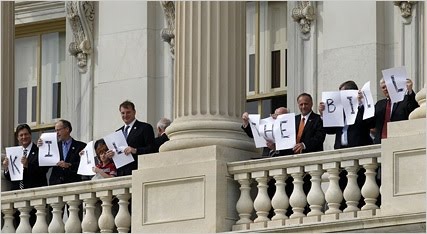
Not so for the Republicans, who were not at all inclined to send Nancy Pelosi roses. Instead they were promoting a viral video of her face, surrounded by flames, with the caption "Fire Nancy Pelosi." If this were the Middle Ages, they'd be burning her flat out at the stake. Since this is 2010, however, stuff like that happens mostly on line. Mostly, but not entirely. While votes for the bill were being counted, a few Congressional Republicans stood outside on the balcony overlooking the mall, holding letters that spelled out "Kill The Bill," egging on the hecklers and Tea Party protestors down below.

Afterwards, as Congressmen were leaving the building, protesters called John Lewis a "nigger." They called Barney Frank a "faggot." They spat on Emanuel Cleaver and Rep. Randy Neugebauer called Bart Stupak a "baby killer," because he had offered up the defining "yes" vote for the bill. "Let's beat the other side to a pulp!" Rep. Steve King, Republican of Iowa, shouted to the last of the Tea Partiers on Sunday night. "Let's chase them down! There's going to be a reckoning." These are not just isolated "fringe" elements carrying on in this manner, as is often reported. They are hard-core Republican Congressmen, who have incorporated themselves into the Tea Party movement.

Later, protestors placed a coffin on Russ Carnahan's lawn. They sent faxes of nooses to Jim Clyburn. In my state, someone tried to cut the propane gas line at Tom Perriello's house --but ended up cutting his brother's line by mistake, because a wrong address had been posted on a website. Meanwhile, ten Democratic members of Congress have had to get increased security and police protection because of threats.

All week long I found myself wanting to sing an old childhood song: "The bear went over the mountain." "The bear went over the mountain. The bear went over the mountain, and what do you think he saw? He saw another mountain, he saw another mountain, and what do you think he did? He climbed the other mountain, etc." [repeat and repeat, ad infinitum]. Democrats just got over one huge mountain, and what do you think they saw? More willful obstruction and escalating threats. Another mountain to climb.

An apopletic John McCain has now gathered up his toys and declared that he will not play with Obama anymore: "No cooperation for the rest of the year." ("This is an adolescent living in the shell of a former statesman," wrote Timothy Egan in the New York Times.) Yesterday I heard on NPR that my state of Virginia has already refused to enact any legislation with a Federal mandate that requires the purchase of health insurance. Many other states are following suit. Since Republicans failed to make health reform Obama's "Waterloo," they will now try to make it into his "Monicagate," in a further effort to tie his presidency up in knots through millions of dollars' worth of obscene law suits and wasteful legal proceedings.

Perhaps the most interesting skirmish of the week may have gone unnoticed by anyone except diehard Washington watchers like me. It involved the sacking of David Frum, a former speechwriter of George W. Bush, and, since 2003, a resident fellow at the American Enterprise Institute (AEI), a conservative think tank. Frum sealed his own fate when he wrote on his blog, FrumForum. that Republicans had suffered their own devastating Waterloo in their loss to President Obama on health reform. "It's hard to exaggerate the magnitude of the disaster," Frum lamented. "We followed the most radical voices in the party and the movement, and they led us to abject and irreversible defeat." The Institute's donors were not happy with Frum's comments. Frum was given his walking papers by AEI President Arthur Brooks.

I append a few reader responses that I found on the net to these various events:

"I have to say that I do believe all of this agitation will lead to a tragedy. I hope it's one that the nation can survive. But the Republicans seem to have decided that they will not give up the right to govern, no matter how much they lose elections. They are willing at this point to use increasingly graphic forms of intimidation. I hope the FBI is taking note." Jane Smiley

"Unfortunately the obstinacy of the Republican party is not funny or cute. It is dangerous and anti-American, however much they drape red, white and blue and a fraudulent "Christianity" over themselves. Following the ugly "tea party" prior to the vote, and the physical attacks and threats after the vote, it is clear that the Republican party is encouraging such actions.
Obama should make an address, informing these people that they live in a democracy, majority vote wins, and any incitement or actual taking of violence will be dealt with by the law - whether coming from the mouths of Limbaugh, Beck or a foaming tea-partier on the street. If nothing is done we can anticipate shortly assassinations and jack-boots.
Not so funny." Jon Jost Seoul, Korea

"When is the story ever going to be about the total obstruction of the Republicans? They apparently care nothing about the people of this country. Of course, since they don't believe in government, they don't care if it works. I will never understand why we elect people to Congress who do not believe in government. This makes no sense." Elin Carrington, ND

In case you are wondering why I write about these matters so obsessively, it is because one day, when the bear climbs over the mountain, it may find, not another mountain, but something truly monstrous. People will wonder how this could possibly have happened in our country? At which point the story, the one that hasn't happened yet, will have already been chronicalled here.