Wednesday, December 28, 2011

Alligators Always Dress for Dinner


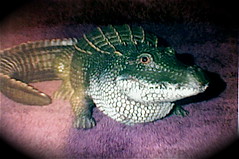
Virgil and I, we really liftoff at Christmas. Holidays have a way of flexing your party muscles and keeping them in condition. It's the time of the year when you might just be inspired to adopt a baby, design a curriculum, or go sailing in some saltwater bay. But when the time comes to open presents, that's when when we both go a little feral, reverting to a wild state. This end-of-the-year holiday blog has been inspired by a Christmas present I got from my friend Jane.

It's a book with the title "Alligators Always Dress for Dinner: An Alphabet Book of Vintage Photographs" by Linda Donigan and Michael Horowitz, a couple who live with their dog, Benny, in the woods of southern Vermont. Combining the alphabet with an assortment of illustrative vintage photographs seems to open up unlimited, over-the-top possibilities for zaniness--none more so than the "A"-is-for-alligators" photo that appears on the cover.

Virgil immediately zeroes in on the two devilish alligators captured in this surreal diorama. While the alligators exchange knowing glances and play to the crowd, the gentleman in the business suit tries somewhat petulantly to get his bowler hat back from the snatcher. Where could this image possibly have come from?

Turns out, it's "From old friend Harvie and his pair of pet 'gators keeping warm during the winter of 1904--in Florida." The image has been cribbed from an old postcard! It seems that in the early 20th century, vacations became part of the lives of working people for the first time--and Florida was a popular destination. By now, Virgil is so excited, he is untying his moccasins and loosening the ribbons from his braids. "Relax," he tells me, "with maybe a little schnapps and a sandwich. Just stretch out while I tell you another surreal story about a man who can ride a unicycle backwards and slice apples in the air with a samurai sword."

Virgil is referring, I discover, to Ashrita Furman, a 67-year-old man and part-owner of a health-food store in Queens, who is the world's leading practitioner of something known as "Guinnessport"--undertaking challenges designed to get you into the Guinness Book of World Records. Amrita Furman, it seems, has set more world records (367) than anybody else. Unbeknownst to me, Virgil had snuck-read all about him in one of my recent New Yorker's.

So I checked out the profile by Alec Wilkenson for myself, and Virgil is absolutely right, of course--this man's exploits will certainly make you whistle over the creek and pound your bare feet on the cold terrazzo. They might even cause you to go bald overnight.

Last June, Furman climbed the mountain above Machu Picchu on peg stilts; in 2005, he covered a mile stretch of The Great Wall of China on a hop ball; and in 1993, he climbed to the snow line of Mt. Fuji on a pogo stick. Furman has also jumped underwater in the Amazon River on a pogo-stick for three hours and forty minutes--and in each case, he set the world record for fastest and longest. I didn't even know people did this kind of stuff!! Twenty-seven thousand jumping jacks done in six hours and forty-five minutes. Walking thirty-three feet in the world's heaviest shoes, which weighed three hundred and twenty-three pounds. Walking, once, in New York, nearly ninety miles with a milk bottle on his head.

But it was really one of Furman's rivals--a widely known French Guinnessport athlete, Michel Lotito--who got my attention, it being Christmas, and therefore the time for culturally ordained overeating. This man cut into pieces and then consumed eighteen bicycles, fifteen shopping carts, some televisons and chandeliers, two beds, a computer, and a single-engine Cessna. In his lifetime (he died a few years ago), he is thought to have eaten nine-hundred tons of metal. Not to be outdone, Furman once tried eating a tree in Queens, having heard that someone had eaten an eleven-foot birch. Can you top this?

Yes, according to the hosts of a new reality show in the Netherlands known as "Guinea Pigs," in which the two co-hosts agreed to indulge in a little cannibalism. They each had tiny pieces of their flesh surgically removed (one from the belly and one from the backside) and then it was sauteed and served up to be eaten. "It is weird," said one of the men, "to look into the eyes of a friend when you are chewing on his belly." You better believe it!

Maybe we all need to rethink our Christmas menus. I mean, Mama Standish's cranberry relish just doesn't play against a metal breakfast of champions, does it? Eating, it turns out, can be a really dangerous edge, if you happen to find yourself up for it. As for me, I'll stick with relish, but I won't speak for Virgil, who has been known to sometimes relish human flesh.

Monday, December 5, 2011

The Wonderbread of Civiliztion


In case you've wondered where I've been these last weeks--MIA from my tiny perch in the library stacks of the vast blogosphere--the truth is I've been doing something as ancient and essential as wrapping Christmas presents, even while avoiding the national nervous breakdown known as presidential politics. (Although I confess to secretly reveling in the moral undoing of that world-class liar, Herman Cain, who I think hoped he would be the last cookie left in the jar. Not--unless, of course, he returns as Newt's running mate for VP, and if that should happen, remember you read it first here, but do not blame me.)

There have, of course, been moments of anxiety interruptus: joy at eating a braised breast of duck with a friend at The Blue Apron; excitement at seeing the new movie "Hugo" in 3D with another friend; and a surprise revisiting of the life and work of Carl Andre via Calvin Tomkins' profile of him in The New Yorker. It's been years since I pondered whether or not Carl Andre pushed his then wife, Cuban artist Ana Mendieta, out of the window of their Spring Street apartment in New York City. The doorman (Tomkins reminds us) heard a woman cry "No, no, no!" just before Mendieta's body slammed down into the street below. At Andre's request, there never was a juried trial, and eventually Andre was acquitted by a judge who claimed there wasn't enough evidence to prove beyond the shadow of a doubt that Andre had committed a crime.

Reading about this again recently reminded me that I once met Ana Mendieta when I visited Iowa State University to give a lecture many years ago. She was not yet famous. The professor who brought me there to speak was living with Mendieta at the time, and I was invited me to their house for dinner. Mendieta cooked us the most delicious Cuban black bean soup, and then showed me pictures of her seemingly premonitional work--imprints of her own body lying in sand, as if she somehow had intuited her terrible fate.

Seeing Martin Scorsese's film "Hugo" last week has led me intuitively to want to write a few words about my old friend, James Hillman, who sadly died in his home in Connecticut on October 27th. I think he would have loved this movie. It is based on a children's book about an orphaned boy who lives in a train station in Paris in the 1930s, snitching broken toys from the toy maker's repair shop and hot croissants from the bakery. If the movie has any message, though, it has to be this: if something in the world is broken, it behooves us to fix it. That is our human purpose, and what gives life its meaning. But it is the way the movie mixes it all up and becomes a monumental tribute to the human imagination, that reminded me so much of Hillman and his work.

Like Scorsese in "Hugo," Hillman was committed to the human imagination as the primary activity of the psyche and as the motor force of civilization. Hillman dedicated his life to the "anima mundi," to instigating a return of soul to the world. And, as his good friend Thomas Moore observes in his prologue to excerpts from Hillman's collected writings, "The Blue Fire," Hillman sought to re-vision psychology by moving it away from emotional personalism and its focus on individual suffering, towards a larger consideration of the life of external objects, and the suffering in the world and in nature--attending to which he considered the true work of the soul. As in the movie, Hillman's work often studies waterworks, streets, railroads, buildings, show business, ecology, bombs, work, education, and architecture.

Here is a wondrous example from "The Blue Fire" of Hillman's ability to "mix it all up." In this particular riff, he humorously channels Freud and Nietzsche, in an almost comic-strip parody of their ideas that quickly becomes, in Hillman's hands, a send-up of the byzantine ways of civilization itself. You really need to read the entire excerpt, but as I say, Hillman knew better than anybody else how to mix it all up:

"When Nietzsche said "God is dead," he had just been served a slice of wonderbread by his sister, and his mouth crammed with an unswallowable gulp of the stuff, she misheard what he was trying to say. Never imagining that a diseased mind like her brother's could make an intelligent comment about what he was eating, she transcribed his remark on the demise of bread as yet another of his attacks on deity. Poor Nietzsche. He was never understood."

"In the same way, some decided that my book on wonderbread ("The Future of an Illusion") was a deliberate attack on the illusion of salvation in "white Christian civilization."...But these critics, as always with my work, missed the point. I was not out to get salvation. I was only trying to save bread....The illiusion we call bread has no future. Nor does the civilization that comes wrapped with it. As long as the prayer goes forth daily to Mister Muffin Man in the Sky to give us this day our daily bread, our flour mills will go on grinding and bleaching, our loaves knowing neither ferment nor crust, and our sandwiches dwelling forever in the house of gumminess and goo...."

"I offer no recipe for bread...But advice I do have: if you would live s long as I, if you want a future that is not illusion, get a nice loaf of Jewish rye. Enjoy!" [Cookbook, 174-177]

Unmistakably, at this point in time, we are witnessing the end of the age of Wonderbread. If you ask any Wall Street Occupier, we may even be facing the end of that illusion, civilization itself. People are becoming aware that their future has been seriously foreclosed. In the current non-trickle-down economy, everyone would love to find, hidden behind that empty cookie jar, one really nice loaf of Jewish rye. True to the spirit of James Hillman, it would be a gift, not from the Muffin Man in the Sky, but from a sympathizer at the local delicatessen.

Monday, November 21, 2011

On Being the Moral Compass for a Nation


All my troubles, Lord, soon be over, all my worries, Lord--about what might happen if Wall Street protesters tried to survive a bitter "Valley Forge" winter in Zuccotti Park--soon were over. Within twenty-four hours of my previous post, the whole Zuccotti encampment vanished overnight without a trace. On November 15th at one a.m., New York police, using tear gas and pepper spray to disperse the crowd, raided the park, removed all the tents and tarps, and tossed everything on the site into the maws of waiting sanitation trucks. Not even the library books were spared.

On that November morning, when the rest of the country woke up, Zuccotti Park had been restored to its former pristine state and resembled nothing so much as an old-growth forest that had been newly clear-cut. The ferocity of the Occupiers' resilience and will power would not be tested here. Sanitary conditions reigned again, the messy remnants of those who had been lamenting the disgrace of humanity's rampant greed dutifully hosed away. Gone, too, was the exemplary democratic village they had so carefully constructed as a rebuke to the crummy, second-rate world they have inherited, with its fatal indifference to those in need and to the very earth itself.

"They had to go," a friend's husband, now 92, told me the next night over dinner. "What they were doing was illegal, camping on someone else's property, and it was unsanitary." Maybe so, I said, but was it more illegal than when we went into Iraq to "shock and awe" the population? Was it more unsanitary than the mess we created there?

Previously, police had brought prisoners released from Riker's Island who had nowhere to go into the park. The homeless and the mentally ill also arrived, but the protesters did not recoil from this invasion. On the contrary, they included these people in their tiny model society, even arranging for on-site treatment by drug counselors and social workers. In one tent, you could get vaccinated against the flu. In another, you could borrow a business suit to go to the bathroom in one of the restaurants nearby without attracting undue attention.

"We decided we wouldn't marginalize these people like the rest of society does," one of the movement's most devoted organizers, Katie Davison, a film-maker in her early 30s, told Michel Greenberg, who has written about Zuccotti Park in a recent New York Review of Books. "I guess we've created our own welfare state, and I mean that in the best sense of the term." Zuccotti Park was not just a tent city. "I want us to be the country's moral touchstone, its unofficial conscience. It's a model for what is good." (I actually cried when I read that.) It was part of the movement's effort to show the world a better, more humanitarian form of democracy, a new kind of social system, not motivated by a corrosive appetite for power, influence, and control of the political system. Occupiers cherish their status as ethical defenders of the 99 %.

"At some point in time," a character muses in Haruki Murakami's latest novel, "IQ84," "the world I knew either vanished or withdrew, and another world came to take its place." Sadly, on November 15th, that analogue replacement world also vanished: it was forcibly evicted. Fortunately for us, however, the story doesn't end with eviction or pepper spray. A huge network of like-minded people has been galvanized, who will not back down in the campaign against plutocracy and greed. Exactly what direction that energy will take now that the model community in Zuccotti Park--symbolic of the movement as a whole--has been dismantled, still remains to be seen. Plans are being developed for a national occupation of the National Mall, the big park that runs between the Capitol and the Lincoln Monument. A national General Assembly is in the works for April 1, which will focus on the failure of Congress to represent the views of the majority of people, and allowing special interest groups to dominate the political process in favor of the 1% at the expense of the 99%.

One Occupy member reports that a rotating team of thirty to forty volunteers, minus their sleeping bags, still patrol the park all night, drinking hot chocolate for warmth. Other Occupiers who came from out of town have found places to sleep at friendly neighborhood churches, and the kitchen still operates out of nearby Trinity Church. It is both ironic and compelling to me that humanity's fate, now playing itself out in the grimmest of ways, will depend on the fate of tandem teams of men and women standing watch and drinking cups of steaming cocoa at two in the morning in an otherwise deserted park at the bottom of Manhattan. But as their story goes, so will go ours as well. Whatever happens to them will be what happens to us. We are the 99%.

Sunday, November 13, 2011

Baby, It's Cold Outside: Freezing for a Fair Deal


When, much too early, winter made a sudden, unwelcome appearance in New York City, arriving in the form of a freak snow storm late in October, the impromptu OWS encampment in Manhattan's Zuccotti Park was likened by some to General George Washington's beleaguered brigades at Valley Forge. Struck by the analogy and concerned for the protesters, I checked out Valley Forge in Wikipedia, because I worry about how these (mostly) young people currently putting their lives on the line for the future of humanity will get through the freezing winter. Here is some of what I read:

"In 1777, with winter about to set in, General George Washington moved his army to Valley Forge in Pennsylvania where new grounds for brigade encampments were selected, and new defense lines were planned and begun. The troops were poorly fed, ill-equipped, weary from long marches, and plagued by critical shortages. Alternating freezing and melting of snow and ice made it impossible to keep dry or warm. Soldiers received irregular supplies of meat and bread, some getting their only nourishment from "fire cake," a tasteless mixture of flour and water. . So severe were conditions at times that Washington despaired "that unless some great and capital change suddenly takes place ... this Army must inevitably ... starve, dissolve, or disperse, in order to obtain subsistence in the best manner they can."

Shortly after that, I found this testimony on the Occupiers' chief website, NationofChange.org, which I check in with every day. It chronicles life inside the movement--people telling their stories and op-ed writing by other well-known figures who support the movement.

"I opened the tent to freezing sheets of blowing, icy rain. Within moments my hands were so frozen they were barely usable...It was my own fault, I should have put on my gloves, but I had lent them to another woman whose hands were purple. It was a trying morning for all of us." Thus writes Bre Lembitz, a 21-year-old student majoring in Economics and Political Science, who took up residence in the park on September 25th, and plans to take another semester off to s continue her organizing efforts on the medical and financial committees. Lembitz sees OWS as the most important movement of her time.

"By five PM, tempers were short," she continues. "No one was dry or warm, we were all standing around in the cold, performing our various duties, and dealing with the other symptoms of the storm. A large majority of the people who are living in the park have never camped before. There had been twenty six cases of hypothermia, and there were emergency procedures in place to take people home...Panic was every where, people were not thinking clearly, but the community came through. One woman showed up three times, once to bring blankets, once to bring shopping bags full of soup, and another time to bring hot chocolate. With tears in her eyes, she brought me the bags of soup and said, 'I wish there was more I could do. I am so proud you are all here, and I beg you not to give up.' ”

The Occupiers have declared themselves allies to "all people who feel wronged by the corporate forces of the world." They are unwilling to leave. Polls show that a majority of Americans agree that wealth is unfairly distributed, with the after-tax income of the richest 1 percent nearly tripling since the 1980s, while everyone else's income has fallen. One of the first people to show up in Zuccotti Park and address the crowd was Naomi Klein, author of"The Shock Doctrine." She spoke about how the system is deeply unjust and careening out of control--how corporations have become more powerful than governments, selfishly trashing the natural world as well as the economy. The struggle to overcome the most powerful economic and political forces on the planet will take many years," she warned in an open-forum discussion on October 6th. "Let's treat this beautiful movement as if it is the most important thing in the world. Because it is. It really is."

During that devastating year at Valley Forge, clothing was wholly inadequate and many soldiers, already wounded from previous battles, died from exposure. Alternating freezing and melting of snow and ice made it impossible to keep dry and allowed for diseases to fester. Although General Washington repeatedly petitioned for relief, Congress was unable to provide it, and the soldiers continued to suffer. Female relatives alleviated some of the suffering by providing valuable services, such as laundry and nursing, that the army desperately needed.

A report last week in the New York Times says that germs are spreading in Zuccotti Park, and many people are getting sick. Under these conditions, new recruits have become harder to find. Meanwhile, the response of the Congressional "Super-committee" has been to debate how much money to take out of the economy by cutting Medicare and Social Security for the elderly, along with many other essential government services--while otherwise seeking ways to lower top income and corporate tax rates. Two days ago, the following urgent request appeared on NationofChange's web newsletter:

"Freezing cold temperatures have hit the east coast and other parts of the nation. We have set out to raise $10,000 to purchase critical food and warmth supplies for protesters in New York City, Boston, Washington DC, Denver, and Chicago. We will put 100% of our goal amount raised towards the purchase of prepared food, zero-degree blankets and sleeping bags, camp cots, tarps, men’s and women’s underwear, rubber boots, wool socks and other essentials.

Help us support these heroes who are making personal sacrifices for our future. Donate generously today!"

"It's time to take sides, folks," Tom Degan writes on his blog, The Rant. "This isn't a fad. This isn't some kind of mass, childish temper tantrum that will pass the moment the weather hits the freezing mark. Wake up and face the dawn. You're either going to be on the right side of history or you're going to be left standing in the sewer. The choice has not been this stark in a century-and-a-half. We've got to put hideous bastards like the Koch Brothers on notice. We need to make all of them realize that the people are standing up and they're not going to stand down under any circumstances."

Herman Cain, who recently bragged that he is "the third brother of the Koch brothers, by another mother," is also bragging that he pulled in $9 million in campaign contributions since October 1. Now just suppose Brother Koch-Cain were to take a paltry $10,000 from that amount and give it to the OWS movement. I expect he would either laugh in my face or snore low in the weeds at such a preposterous thought. It will never happen. That is precisely the reason so many people have become explosive, forging another Valley Forge even at the risk of freezing themselves to death.

Sunday, October 23, 2011

"Mink Coats Don't Trickle Down"


So how to begin to describe this latest protest movement, Occupy Wall Street, anyway--is it fish, flesh, fowl, or (as my mother used to say) good red herring?

Reactions vary extremely across the board, all the way from it's "the beginnings of a possible second American Revolution" to the crude referencing of "growing mobs that are pitting Americans against Americans" by Eric Cantor. So is this really "class warfare," as the Republicans would have it, or rather "a holy space between the towers of money?" as Naomi Klein describes it? Is what we are witnessing in Zuccotti Park just a few "soggy sleep-ins and warmed-over anarchism" or is it "a wide-open place for people to find each other" during "an inevitable moment for America"?

The answer is that nobody really knows. That is why both Zuccotti Park's cheering supporters and its mocking detractors are all holding their breath in anticipation of how this will turn out. What is yet to be determined is whether we are, finally, in the past 5-6 weeks of an unforeseen occupation, witnessing a brave new world rising up out of the ashes of right-wing nihilism and corporate greed, or the beginnings of a nightmare scenario that will end in chaos and destruction--an updated version of the French Revolution where the streets were running with blood.

So where am I, in trying to assess all of this? Caught, I expect, in the crossfire of my own acute emotions, somewhere between elation and fear. There seem to be as many ways of responding to what is happening as there are protesters out there protesting. No one knows for sure whether the movement can continue (the protesters claim to be unstoppable and insist that they can and will continue indefinitely). So far, what they have accomplished is to annex a park near the New York stock Exchange, hold marches and meetings, fend off eviction, spur similar protests around the nation and even the globe, and set up a leaderless mini-society that functions, so far, in a remarkably orderly way, with working groups that run everything from meals and media technology to sanitation. They have even organized a library, as well as "family sleep-overs" so that sympathizers, who feel that their children's futures have been compromised, can bring them along and spend the night.

No one really knows, however, whether Occupy Wall Street will change anything or has a chance of succeeding, given the entrenched forces arrayed against it. One thing we do know is that when leaders pursue their own agendas and stop thinking about the interests of their people, they lose the support of their people. The movement, with its motto of “we are the 99 percent,” has been criticized by many for its lack of coherent demands, but one of the organizers, Yotam Marom, claims that's silly. "We're occupying Wall Street. It should be pretty well clear what we want changed." OWS is fighting both to strengthen democracy, and to end the domination of the big money interests which are seeking to destroy it.

"I think it is a good thing that the occupation movement is not making specific demands," says George Lakoff, the world's expert on how best to frame your agenda to get the results you want. "If it did, the movement would become about those demands. If the demands were not met, the movement would be seen as having failed." In his essay "A Framing Memo to Occupy Wall Street" published in the Huffington Post, Lakoff proposes that the OWS movement is moral in nature, and that what the occupiers really want is for the country to change its moral focus.

"It is easy to find useful policies; hundreds have been suggested," he writes. "It is harder to find a moral focus and stick to it. If the movement is to frame itself, it should be on the basis of its moral focus, not a particular agenda or list of policy demands." If the moral focus of America changes, new people will be elected, and the policies will follow. "Without a change of moral focus," Lakoff says, "the conservative world-view that has brought us to the present disastrous and dangerous moment will continue to prevail."

For the moment, I'm totally happy with his idea of trying to change the moral focus of our country. Let's see what happens when crosses are painted over with polka dots. If it works--if somehow, against all the odds, OWS manages to steal the right-wing Putsch--then maybe, in some better future, crosses will stand, not for the crucified Jesus, but for some new, emergent X chromosome in our species that will no longer be hellbent on its own destruction.

Saturday, October 15, 2011

Herman Cain Is Not Red Riding Hood


I was amused almost to the point of desperation at Deborah Ring's characterization (Oct.13th in the Roanoke Times) of Herman Cain--the former Godfather's Pizza CEO who has recently catapulted to the top of the GOP presidential race--as someone who will clean up the mess in Washington because he is a "new face," and not an insider. "He does not owe any PAC, union, or corporation anything," she writes.

Cain may not come from the ranks of professional politics, but he is absolutely marbled with the financial fat of those corporate billionaire backers of the Tea Party, the Koch brothers. This is meant to be a well-kept secret,Tea Party affiliation no longer being quite the passport into politics it was just a year ago--and so far, the connection seems to have gone unnoticed by political and talk-show pundits. It was not surprising, therefore, that on his kick-off bus tour in Tennessee the other day, Cain told the crowd he will not name his policy advisers to protect them from attacking critics. "They're my advisers, not yours," he snapped.

If you want the real scoop on exactly how lily-white the latest Republican front-runner really is, you can check out the particulars online in Scott Keyes' article about the relationship between Cain and his billionaire pals at thinkprogress.org. There you will find a spectacle with a kick: Cain's rise from niche radio host and pizza CEO to presidential front-runner appears to have been largely fueled by the Koch network.

In an article thick with well- documented links, Keyes maps out the history of this extensive connection, showing how, dating back to 2005, Cain held an official position in the Koch-funded group Americans for Prosperity that offered him immersive opportunities to barnstorm the country, give speeches, hold town-hall meetings, and generally spruce up his skills for an eventual presidential bid. Cain's campaign manager, Mark Block, was a former president of Americans for Prosperity's Wisconsin chapter and is credited with persuading Cain to run for president. Block also has a history, it seems, of electoral dirty tricks, and was once fined $15,000 for violating Wisconsin electoral law.

In January, Cain attended the Koch brothers private biannual meeting in Palm Springs of top right-wing corporate and political figures in order to coordinate strategy and raise money for the conservative movement. He also traveled to Wisconsin to support Governor Scott Walker's union-busting efforts, which were equally fueled by the Koch brothers, as well as to a Koch-based anti-climate rally in New York in June. If Cain's catchy "9-9-9" across-the-board tax plan were ever instigated, the Koch brothers would personally see their tax rates fall from 23 percent to around 11 percent.

In sum, we are not talking about some free-wheeling pizza populist here, with no campaign structure and very little money. Herman Cain is not quite the untainted, folksy, down-home "new face" that Ring makes him out to be. Rather, he is quite the clever teacup, whose bristling subtext is that of being front man for the most dangerous right-wing corporatists now threatening to take over our country. Cain has already named Paul Ryan and Jim deMint for unspecified slots in his administration. Does all this make your radar system flash on red alert? It does mine.

Tuesday, October 4, 2011

Black Marbles


"I have never had so challenging an assignment as finding people who approve of Congress," Joel Stein writes in the 10/10 issue of Time. Stein has spent the last two weeks on assignment in Los Angeles, searching for people who would join him for a meal and tell him why they don't hate Congress. "It was the hardest job of my life," he says. Recent polls show a 12 percent approval for Congress, which matches the lowest rating ever recorded, and Stein considers even that has got to be over-inflated. Finally he did manage to track down five people willing to talk with him, two of whom wouldn't allow him to print their names because they didn't want anyone to know they actually think Congress is okay.

Three of the five who ended up convening with him for brunch at the Alcove Cafe were Tea Party enthusiasts, one of whom declared, "A Congress that doesn't get anything done delights me." This was a doctor who wanted to remain anonymous because he feared if his patients were to know his views, they would leave him. One of the others, a housewife with a PhD, proclaimed her nostalgia for the time Newt Gingrich succeeded in shutting the government down. When asked by Stein to name something they thought the Senate and House did well, a lawyer answered, "Give me a second. I know it's there. It'll come to me."

For almost three years, Barack Obama tried to work with both parties in Congress "to get things done," until he finally got it that he would never get any cooperation or support from Republicans. So now, with his approval rating at an all time low, he has taken to the hills to campaign for his American Jobs Act--a mixture of tax cuts and government spending totaling $447 billion--entirely on his own, looking exhausted and demoralized, but hanging tough, like Atlas holding up the world. Republicans may never even bring the bill to the table for a vote. For them, nothing happens unless the rich get their tax cut.

"The country needs a leader," Peggy Noonan crooned on "Meet the Press," this Sunday, back to her latest refrain--Obama hasn't managed to bring the parties together, nor has he succeeded in making Republicans fear him. Meanwhile, America's politics have turned into a chicken-and-egg game over which came first: Republican obstructionism or Obama's failure to lead. Meantime, the rest of us have become like black marbles caught in a whirlpool of blame.

In The New Yorker [09/26], James Surowiecki presents reasons the GOP could actually get away with their obstructionism without being punished for it at the polls. Responsibility for the economy, he claims, now belongs to Obama and and the Dems, and since Republicans control only one house of Congress, they can more easily dodge blame because they've had little chance to enact anything on their own. According to polls, most swing voters are strongly in favor of reducing deficits, and voters in general don't expect Republicans to do much about jobs anyway, so they are not penalized as much for their inaction. (This last has got to be an argument that depends, in all good faith, on the rain.) In fact, uncooperative Republicans are really just delivering what their constituencies expect. In the run-up to last year's midterms, Republicans were explicit in their opposition to stimulus programs and to any tax-and-spend policies--and they won a landslide victory. Surowiecki concludes that Americans may want the government to get the economy moving again, but when push comes to shove, they vote for a different story. So, for now, he claims, it is not only our representatives who are to blame. It's ourselves. We are the culprits who voted them in. And, as black marbles caught up in the whirlpool of blame, which of us can honestly claim NOT to have felt all the emotions as itemized below?

To BLAME, [per Roget's Thesaurus] = to disapprove, not admire, fail to appreciate, have no praise for, not think much of, take a dim view of, censor, disfavor, lament, shout down, boo, hiss, throw mud, pour vitriol, lambast, call names, curse, vilify, reproach, denounce, stigmatize, sneer, taunt, trounce, come down on like a ton of bricks, revile, think the worst, condemn.

Who, at this point, is not in search of a wailing wall, not feeling a need to cram hair balls down somebody's else's throat? In doing so, however, we ignore at our own peril (in the words of Ray Bradbury) that "poison can destroy minds even as it can destroy flesh." "Teach me, he writes in "Zen in the Art of Writing," "how to be sick then, in the right time and place, so that I may again walk in the fields, and with the wise and smiling dogs know enough to chew sweet grass."

If these are really our choices--becoming black marbles or chewing sweet grass--which of them should one choose? I ask Virgil, my trusted alligator-muse, to give me his opinion. Considering the state of everything today, how can one NOT want to play the blame game? It would be like asking tribes give up their bingo rights on the reservation.

In the winking of a lighthouse, Virgil has his answer at the ready "Your country lost its legal standing when it argued and convinced the Supreme Court that corporations are people and have rights. Now, all the cases in which you are still hoping to defend your rights are prepared by skeletons in a bone court."

So what does that mean?" I ask. "Listen," says Virgil, "you people are insane, without a doubt insane. Not every donna can be prima. You're going backward into the future, where you are surely going to lose. To paraphrase from one of your most illustrious poets, you would rather be ruined than change. The national debt is rising at $46,000 per second, so I would bag the marbles and ditch the sweet grass. It is already known that resentment is like drinking poison and then waiting for the other person to die. Personally, in a predicament like yours, I'd reach for pistachios, with maybe a dash of wild ginseng."

After dropping that bit of alligatorial advice, Virgil brushes the dust from his leather trousers and rises to go. He has new orders to fill from more than a dozen states and countries, and even though his percentage is pretty low, he still earns more than he needs to expand his empire and add to his collection of ladies' shoes. Riding waves of electrified delirium, the crafty alligator quickly disappears, sleek as a Bedouin in the night.