Wednesday, March 25, 2009

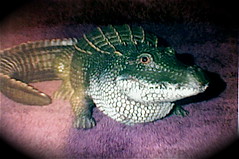
Virgil Meets the Duckheadtail Crocodile


Last Saturday Virgil found a new friend in, of all places, Lynchburg. I was invited to participate in a panel discussion at the Maier Museum in conjunction with an exhibition of the work of two artists, Sue Johnson and Pam Longobardi. I wasn't familiar with the work of either of them, so I was wasn't wildly enthusiastic about accepting the invitation. It turns out I was dead wrong. Fortunately the curator, Martha Johnson, gently persisted, sending me extensive documentation, and when I glimpsed the portrait of Virgil's fabulous new potential soul-mate in Sue Johnson's catalogue called "The Alternate Encyclopedia," I knew I was supposed to go--at the very least for Virgil's benefit. Virgil prides himself on his reputation for eccentricity and likes to burnish it any chance he gets, (I also received, subsequently, a folder of information from Pam Longobardi, and was also very drawn to her current project, "Drifters," but more about this in a separate post.) Meanwhile it was refreshing to leave the war zone of economic collapse and immerse myself instead in the Borges-like pantheon of Sue Johnson's creatures.

Sue describes herself as a "surrealvisionarymorphicnaturalist," who inhabits a parallel universe in which James Audubon, Max Ernst, Walt Disney, and assorted birds and animals all take tea together, like nineteenth-century dandies, at Alice's table in Wonderland. Incorporate into this cast of characters the likes of Pegasus, Peter Cottontail, and the Ugly Duckling, subject them to dissection as if they were scientific specimens, throw in a few old Bestiaries, anatomy charts, a bit of botany and genetic engineering, and you enter the eerie but utterly irresistible world of Sue Johnson's encyclopedias and cabinets of curiosities, where everything seems scientifically real, but not quite. "I'm very drawn to cross-sections," she says, "as a way of exposing things we don't normally see."

I am also drawn to her free-associative, evocative writing, as well as her images. "The Alternate Encyclopedia," for instance, also contains an alternate Table of Contents, from which I steal the following eccentric tidbits:

"Spelling bees suspended across the globe...Snakes in liquid...The last buffalo sighted ion Duluth....Common workman's wrench and deep-sea shrimp are relatives...Plastic bags prove their worth...Olive loaf aids digestion...Startling proof offered that moon is made of compressed moon-rock material...Local zoo now empty." Sue Johnson teaches at St Mary's College in MD. You can check out this work on her website for more treats at: www.suejohnson1.com

As for Virgil, he remains in awe at all those ducks reincarnated in a brother crocodile's tail. He has determined that if the ducks all quack at once, or if they whistle the entire parts of string quartets, it registers at the oceanography lab in Tokyo. Even the sound of one duck quacking is almost more than he can bear, and inspires him to dance along, something he just loves to do..

Thursday, March 19, 2009

A Lesson of Buttons and Bonnets

It's still No. 1 on the hit-parade: The Economy. Forget UGH, or AARGH. This week's phrase-making addition to the vocabulary of revulsion is, well, AIG. (Pronounce it "egg," or "eck," and you'll eventually get to "ick.") Those 70-odd bonuses, paid out it would seem, with government bailout money, to CEOs, has set the entire country on fire. We could see heads rolling in the streets before it is all over. So far, we're not allowed to know the names of the recipients, because it could be their heads rolling, quite literally, given the onslaught of threats (to strangle entire families with wire coat-hangers, for instance) that have been issued by an enraged populace. This latest injustice is a stone in the public's shoe, as one NPR commentator stated, that has to be removed. That's putting it mildly; it reads to me like a possible prelude to a home-grown French Revolution--which is why Congress plans on clawing the money back through taxes.

"It seems as though it would be pretty easy to upend a bonus contract that must read something like: 'If you ruin the world economy, we’ll pay you an extra million,' " quips Maureen Dowd, Queen of Snark, in the New York Times. "What President Obama should have said to the blood-sucking bums at A.I.G.," she writes, "many of them foreigners who were working at the louche London unit, was quite simple: 'We stopped the checks. They’re immoral. If you want Americans’ hard-earned cash as a reward for burning up their jobs, homes and savings, sue me.' ”

Obama, however, still has some tricks left up his sleeve. He will probably turn the tables and use AIG as an example to catalyze public support for significant regulatory reform. Republicans, eat your heart out!

Meanwhile, it's probably no accident that every second cartoon in the New Yorker each week pertains to the economy. Infusions of humor injected into the public's stiffened jaws allow them to briefly shake, jiggle and bounce. A good laugh never hurts. So this guy comes up to a hot-dog stand on the street intending to inquire about a job. But there are already eight other men huddled under the umbrella, tongs in hand ready to serve a hot dog to the next customer. "Sorry," reads the caption. "We don't need anyone at the moment." Then there are the two women standing in front of a store front whose window is filled with sale signs of 50-75% off. "Finally!" one says to the other, a smile breaking through her furrowed brow. "Cheap is the new black!"

Synchronistically, I have to say I also enjoyed the "Shouts & Murmurs" column in the March 16th New Yorker by Paul Rudner: "Confessions of a Pilgrim Shopaholic." The narrator, one Rebecca Hamshill, is living in Plymouth Colony, having arrived there in 1626. During her first year in the New World, she traveled to Boston to purchase a thimbleful of salt, and five years later, she goes back again to get another one. "I am out of control," she reports. Her mind is consumed with nothing but thoughts of spending.

At one point, she points to the story of another profligate like herself but in the Virginia Colony, who bartered her second child to a local tradesman for a wooden button (all this could have been written by James Howard Kunstler on a good-hair day, were he more funny, but it wasn't). Other women became so envious of her button that they ripped her limbs from her torso and ate them. (AIG palookas beware! It could happen to you.) Eventually her demon of greed requires a public exorcism, presided over by the town pastor with all the villagers repeating the Lord's Prayer.

As the villagers lay their hands upon her, the demon cackles and swears: "A bonnet! Bring me another bonnet! A peaked black bonnet as fine as any widow's!" At which point, Rebecca loses consciousness. When she wakes up the next day, her demon has vanished, "gone back to his fetid underworld."

The word "underworld" unexpectedly conjures up Virgil, my alligator assistant, who arrives suddenly, smelling of hair oil and some kind of food. He nods his head in vehement approbation, and starts making the random, spontaneous remarks that are his trademark, and so often oddly appropriate.

"This is Hello Day for all those CEO political lepers," he says. "You see what can happen to folks who crave too many wooden buttons and black bonnets. My advice to you all is, do not be purposely troublesome. The mojito fountain is no longer operating as usual--so Baby, it's time to meet the bath water. If not, you too will probably be going the way of the auk and the dodo, falling into extinction."

Then, after a pause, I see Virgil step out, an ordinary alligator again, and make his way back to the terminal.

Saturday, March 14, 2009

Tiptoeing through the Economic Jigsaw

Many in the top brass on Wall Street are wondering whether Secretary of Treasury Tim Geithner is the right man for putting these economic bad times behind us. Being an amateur in fiscal matters myself, I'm hardly qualified to judge, but I can say this much. After watching an hour-long interview this week with Geithner on Charlie Rose, Geithner comes off as someone with phenomenal powers of persuasion.

I've watched dozens of these Rose interviews, but not once have I ever witnessed such heights of concentrated alertness from any mere mortal. Not for a nanosecond did Geithner ever unglue his eyes from those of his interlocutor sitting across the table, nor pause to search for the precise word he needed. No momentary confusion or obfuscatory verbiage ever tainted his unassailable flawlessness at every point. In Geithner's vision, the economy is like some intricate jigsaw, in which all the disparate, ailing pieces merely await the right puzzlemaster, perhaps Geithner himself, able to reassemble the parts in one suave stroke, bringing coherency out of chaos again. Completely absorbed in his words, I had to wonder if Geithner could be right--could indeed be a one-man antibody for a rogue economy, who might actually succeed in setting things right again, if we would just follow his lead. I was certainly tempted to surrender to his expertise and suggestions of inevitable recovery. But then, a short time later, I went back to my reading of James Howard Kunstler's novel, "World Made by Hand," (which I promised to blog about in my previous post), and was immediately stopped dead in my tracks with wondering: When is happy talk like Geithner's merely cosmetic? When is it useful? When is it dubious?

The contrast between Geithner and Kunstler is nothing less than startling, like a long-running movie made by two different directors. Kunstler's mortuary novel is set in a little backwater town, Union Grove, in upstate New York (where the Battenkill River runs into the Hudson). Not only has economic recovery not taken place, but a couple of unspecified terrorist attacks have destroyed several major metropolises and vaporized the Federal Government. Ocean surges during a hurricane have left parts of Manhattan and Brooklyn uninhabitable. So what is the world, as seen through Kunstler's eyes, like after collapse?

Here, from my notes as I went along, are some key elements:

"Among us survivors were many who were confused and despondent," states the main character, Robert, who has lost his wife to encephalitis, his daughter to flu (there are no antibiotics or refrigeration), and his son, who took off at age 15 and has not been seen or heard from again. It's the end of the fossil-fuel-driven economy; there are no no laws, no infrastructure, no industry, no oil, no automobiles, no radio, no TV, phones, mail, or recreational shopping, no coffee. In this scarred remnant of our previous existence, people live by fishing, trading, and carpentry. Survivalism mixes with an unrelenting sense of loss: "It was chilling to reflect on how well the world used to work and how much we'd lost...I tried to avoid nostalgia because it could destroy you." In Kunstler's anthropology of the future, those individuals whose lives happened in the old days are the ones most devastated by this scarred world that has become a salvage operation, its scattered populations making do with lumber and sheet metal collected from derelict buildings, and getting by with the good will of helpful neighbors. In short, there has been no return to "normality."

Presumably the truth lies somewhere between Geithner's "happy talk" and Kunstler's grim vision. Then again, maybe not. It's hard to know. "I've read everything on the subprime-mortgage and banking crises I can get my hands on, writes editor Graydon Carter in the current issue of Vanity Fair, "and I still don't understand much of it." (This is the hot new club of which we are all now card-carrying members.) "As far as the global economic crisis goes," Carter states, "part of me thinks that the U.S. has gone off a cliff pretty much the way Wile E. Coyote does in the Road Runner cartoons. He doesn't drop immediately; he's suspended in midair. He knows he shouldn't be out there, but he's not plunging! Filled with hope, he begins to gingerly tiptoe his way back to the ledge. He's almost made it--he's not going to fall! And then, with a puff of dust, he's gone, plummeting far, far down into the canyon. As a nation, we might just be in the tiptoeing stage: we know we've screwed up big time, but we're praying that we can get back to the ledge before gravity takes over."

One thing is sure: there's not much room left to maneuver.

Tuesday, March 3, 2009

Owning Up to the Mess

In a recent article by Conservative columnist Peggy Noonan, she confesses that after his major speech before the Houses of Congress last week, she has finally accepted that Barack Obama really is her president. It became clear to her that whatever difficulties and debacles surround him, Obama convincingly communicates to the public that someone is at last in charge. "Someone's in the kitchen," she says. "Someone's cooking."

"Mr. Obama doesn't do jaunty," she added. "He did not leave people thinking, now I know we will defeat this calamity. But he did leave them feeling, now I know someone's in charge, finally someone's taken ownership of the mess." It's a huge relief, as Noonan says, to have someone in office who is actually minding the store, and to know that this time around, we have a President who is stepping up to the plate. I felt so exhilarated myself by this feeling of relief that I even bought a tee-shirt and a necklace of different colored, blue-glass beads--things I don't really need. For an hour or so I morphed back into being a happy, oblivious consumer, but my high spirits did not last. It didn't take much before I lapsed back into worry mode again, because I realize that no matter who is doing the cooking, we are still fucked. Even if the smartest guy in the room, bar none, serves up the Mother of All Banquets, we may not defeat this calamity. I know to say this is the mark of a "debilitating pessimism," and I will not be looked on favorably for spending time in this dismal place--it is not the way to win friends and influence people--but there it is: my dirty secret. I confess I'm not sure even (my) beloved Barack is ready to face the kind of changes we are probably in for.

The fact that we have moved out of the previous ongoing fiasco of governance into the miracle of real leadership has not stanched the massive hemorrhaging of the global financial system. On his blog, Clusterfuck Nation (http://jameshowardkunstler.typepad.com) Kunstler, a Peak Oil expert, dares to ask the question nobody wants to ask, because the true answer may just be too death-dealing: Is the USA in recession, depression, or collapse? We're now at 340 pink slips per hour, but the debate continues to revolve around whether to call what is happening a recession or a depression. Except for a handful of folks like Kunstler, no one wants to stare down at ground zero and enlist the dreaded word: ongoing "collapse."

Looking at the world through the President's eyes, normality will return. Economic confidence will return, but "not overnight." The consumer economy will stand on its feet again and resume "growth" mode, albeit not before mammoth cash infusions and technological innovations that will make everything more environmentally sustainable. Looking at the world through Kunstler's eyes, however (a vision which is sadly closer to my own), the consumer era is over for good, and most of what has been lost in 2008 will not be recovered; in Kunstler's words, "enterprises, personal fortunes, chattels, reputations." Technology will not be able to rescue us from our fossil-fuel predicament, and we should be facing that fact, according to Kunstler, instead of imagining ways and mounting campaigns to sustain the unsustainable: "electric cars or diesel-flavored algae excreta," and "drive-in espresso stations...run on a combination of solar and wind power."

It's not that Kunstler doesn't support and admire Obama. He voted for him. However, "I fret about the measures he'll promote to rescue the the Status Quo....I am especially concerned," he writes, "about an infrastructure stimulus project aimed at highway improvement at the expense of public transit...[because] the car system is going to fail in manifold ways whether we like it or not." The impossibility of getting car loans or paying for fuel will escalate the impending collapse of an industry already on its last legs and going into bankruptcy. Eventually, Kunstler believes even the federal government will flounder just like General Motors, Citicorp, and other giant corporations have already floundered; eventually even counties, municipalities, and states will all 'join in the bankruptcy fiesta." Maintaining public services like water systems, sewage treatments, and even food distribution will become impossible. Danger and deprivation will be the new and disturbing name of the game. It's not a pretty picture for the human race, and the end is not happy. You can understand why Obama, and the rest of America, refuses to go there. It's just too dark and desperate.

Kunstler has written a novel called "World Made by Hand, in order to give us the feel, in fictionalized form, of what that future may look like when all fantasies of the "growth economy" are long gone. I am currently reading his book, and will probably blog about it in another post. Meanwhile, in the current entry on his blog, he has this to say:

"If we're really lucky, human affairs will eventually reorganize at a lower scale of activity, governance, civility, and economy. Every week, the failure to recognize the nature of our predicament thrusts us further into the uncharted territory of hardship. The task of government right now is not to prop up doomed systems at their current scales of failure, but to prepare the public to rebuild our systems at smaller scales....If the US government is going to try to make remedial policy for anything, it better start with agriculture, to promote local, smaller-scaled farming using methods that are much less dependent on oil byproducts and capital injections."

The post-industrial, post-fossil fuel, post-technological, and post-consumer society will definitely need to have its agrarian ducks in a row, if it is going to survive.

Thursday, February 26, 2009

Archangel Gabriel & the Pink Bathing Suit


Last week at our salon meeting, I told a story about how I once stole a shocking-pink velvet bathing suit I couldn't live without and couldn't otherwise afford from Saks Fifth Avenue. It was shortly after I'd finished reading Jean Genet's "The Thief's Journal," and I was about 21 years old. In the interest of self-disclosure, this was my one and only theft, historic and literary-induced. But it was in an era before surveillance cameras were installed inside dressing rooms. I knew that if I made it out of the store and as far as the street with the item in my black attache case, I would be unassailable, once outside the immediate premises. I took the elevator down to the street level, left the store, and unabashedly continued walking up Fifth Avenue feeling elatedly proud of myself--when suddenly, I felt an ominous tap on the shoulder from someone who had come up from behind. I can still feel the "Uh oh, now I'm done for" as physical fear flooded my body. I turned around to squarely face my accoster. Upon which, the man said to me: "Do you happen to know the correct time?"

Thinking about this weird synchronicity of the stranger's ominous, annunciatory tap on my shoulder that day remains striking; nothing similar has ever happened to me before or since. I tend to think the universe probably had its eye on me, and the benign tap was its way of saying, "We'll let you off the hook this time, dude, but don't you ever try this kind of thing again!"

Subsequently this week, I wrote to Michael Rumaker, sending him this story--we have been emailing ever since I published my last blog about his book, "Black Mountain Days"-- he had asked me at one point if I was psychic. I told him he could judge for himself once he'd read my memoir, "Living the Magical Life." He wrote me back that the "lovely moment of that stranger tapping you on the shoulder on Fifth Ave. after you'd swiped the pink bathing suit from Saks was your better angel perhaps asking really, as you say, 'Do you have the time for this, even though you stole from a rich corporation who could well afford the loss?'" Michael suggested that the man tapping me on the shoulder might have been a messenger angel: "Messenger angels are everywhere," he said, "and come in various guises and are often perceived as the "lowest of the low" who have nothing to teach us. but they have much we need to learn, to hear. I do believe the fields of energy we project pull us to and pull to us the people we need to meet, in, to borrow your word, the truly "meaningful" coincidence, for better or worse. Sometimes it's a momentary tap on the shoulder, and sometimes it's sartori, blow of light! as it was with Olson smiting me awake at Black Mountain."

Yes, I definitely believe in messenger angels, and as any reader of this blog knows well, I spend much time divining answers to my questions. My own awakening to synchronicity as perhaps the central force field in the universe came when I was writing "Living the Magical Life." It may be the only memoir extant which constructs its narrative quite deliberately (I realized halfway through writing it) by mapping synchronicities as the nodal points actually weaving my life together. By which I mean that all of the life-changing things that happened to me and led me down certain paths, seem to have occurred independently of my own intentions. Things I desperately wanted, for instance, didn't pan out, but other things did--many of them just appearing, out of nowhere, seemingly out of the blue, and shooting me through like Elsa Maxwell out of a cannon ball.

Then my friend Jane wrote to me about Obama's speech on Tuesday night. She likened Obama to the Archangel Gabriel, and the dismissive faces and body language of certain Republicans in the audience, by way of contrast, to the distorted grimaces of Hieronymous Bosch figures in "The Garden of Earthly Delights: "pig-headed, inbred, and unpromising." And I thought, yes, Obama's speech WAS an annunciation of sorts, a message of future success for our country. But it was also the ominous tap on the shoulder to say, "Don't let's ever try this sort of unmitigated fiscal nonsense again!"

Then I Googled " Archangel Gabriel" for clues. Gabriel, if you don't already know, was the angel sent to Mary to inform her that she would conceive Jesus, but intriguingly, he was also the angel who revealed the Koran to the prophet Mohammed in the mosque of Medina. Undoubtedly another auspicious synchronicity erupting into plain view.

Last night the Obamas entertained Stevie Wonder in the White House, who was receiving the Library of Congress's Gershwin Prize for popular music. The president is a well-known fan — Wonder performed at his nominating convention in Denver last summer and at a Lincoln Memorial concert before his January inauguration. "I think it's fair to say that had I not been a Stevie Wonder fan, Michelle might not have dated me, we might not have married," Obama said, with his wife sitting in the front row. "The fact that we agreed on Stevie was part of the essence of our courtship."

Synchronicities, if you follow them carefully, long and far enough, are surely the marks of a sophisticated, dark wizard. Watch next for Republican Bobby Jindal, giving another speech on the steps of the White House, wearing dreadlocks and dressed in a stolen pink bathing suit, a copy of Jean Genet's "The Thief's Journal" and of the Koran secreted in his black attache case. God will be whispering in your ear, "It's all good." The picture above is of Gabriel, Georgian, 13th century.

Sunday, February 22, 2009

Art's Boom and Bust: A Two-Book Seminar

To read these two compelling books--"Seven Days in the Art World" by Sarah Thornton and "Art and Upheaval: Artists on the World's Frontlines" by William Cleveland--back-to-back, is to immerse oneself in radically contrasting habitats. Sarah Thornton’s book offers an insider’s view into the market-driven art world, its institutional hierarchies, privileged elites, and theatrical excitements, while "Art and Upheaval" plunges us into the world’s most dangerous hotspots, where interactive networks of unknown artists toil on the frontlines, responding to scenes of tragedy and targeting distressed communities in real need of help. The settings are as alien from each other as chalk and cheese but, in the curious way that opposites provoke and create a spur for consciousness, they also dovetail, like yin and yang. What they demonstrate is that art today has no stable or knowable center; it arises in contexts that bear no causal relationship to one another. This becomes a stunning object lesson in how differently artists in the 21st century can perceive their role and purpose.

I am presenting these two books now as a potential, ready-made, seminar course. Any issues-oriented professor of contemporary art who may be reading this blog and wants to stir the pot intensely with minimal means should take note: there is enough material here to stir debate for an entire semester's worth of classes. Side by side, these books put into stark focus the way our world may be changing as a result of global economic meltdown. It may well be that the art-world's boom days are numbered, headed for the dust bin of history, along with all the other financial bubbles spawned by rogue capitalism in recent decades. If art continues to exist, it will have to transform into something quite different than what we have been used to glutting the galleries with.

Like Albert Camus, a writer who worked in the French underground during World War II, Cleveland’s artists have embraced the struggle to construct what Camus once described as “an art of living in times of catastrophe.” They seek, with their art, to keep the world from destroying itself “by fighting openly against the death instinct at work in our history.” In our own catastrophic times, there is a remarkable dichotomy between artists who believe unfailingly in the autonomy and self-sufficiency of art, and those who maintain that art should have some socially redeeming purpose. A sentence from my own book, The Reenchantment of Art, could be construed as the thrust of Cleveland’s entire narrative: “We need an art that transcends the distanced formality of aesthetics and dares to respond to the cries of the world.”

When I was an art student of Robert Motherwell’s during the 1950s, our class studied a single essay by Ortega y Gasset, “The Dehumanization of Art,” for many weeks. Written in 1925, Ortega’s essay launched the emerging mindset of the modern artist as a creator of art that should be divorced from “the world of practical affairs.” Modern art, Ortega claimed, irreverently “flouts itself.” Not only does it choose to view itself as “a thing of no consequence,” it also rejects any concept of the artist as savior.

Nobody could have foreseen, in this quite deliberate separation of art from life, the rise of a multimillion-dollar industry—that gaudy and totally artificial habitat known as the “art world”—which would eventually become home to the kind of art that “flouts itself.” But that is what happened. Thornton, who has a B.A. in art history and a PhD in cultural sociology, probes brilliantly and deeply into this world, giving us penetrating glimpses without any malice or the remotest taste of iron in her mouth.

So what, besides hierarchies of status, reputation, and wealth, makes the art world the art world? Most notably, it is the power to define art. Besides that, the art world is where the professionals hang out. By hanging out, socializing, and interviewing high-profile artists, dealers, curators, critics, collectors, and auction-house experts during five years of “participatory” research, Thornton filled forty-seven blue notebooks full of exciting artistic juju. Her book explores seven distinct subcultures: an auction sale at Christie’s in Manhattan; an art “crit” class at CalArts in Los Angeles; the Basel Art Fair; the award ceremony for the prestigious Turner Prize in the UK; the editorial offices of ARTFORUM magazine; a studio visit with Japanese Pop artist Takashi Mirakami; and the Venice Biennale. The final product reads like a fabulously good novel you can’t put down.

In contrast, the communities of upheaval inhabited by William Cleveland’s artists are both spiritually and geographically remote from the glamorous buzz of Thornton’s art world: six embattled communities on five continents—Northern Ireland, Cambodia, South Africa, Watts, CA., Australia, and the former Yugoslavia—places convulsed by war, and racial, religious, or political strife, offering excitement of a very different kind. Cleveland’s experiences in these places have led him to a quite divergent picture of art’s potential—as a channel for healing human grief. This work is often dangerous, carried on in the face of “vicious politics.” “Imagine knowing,” he writes, “that your art making could get you killed, but doing it anyway.”

Cleveland’s in-depth writing about artists in far corners pulling together and creating moral centers for healing and political reconciliation is sometimes ponderous, but couldn’t be more timely, or relevant, now that we have a global leader in Barack Obama who has made community-organizing the centerpiece of his presidency. It may just be that we have outlived the long period of ethical (and aesthetic) neutrality in our culture, now that politics is finally catching up with art.

Monday, February 16, 2009

Black Mountain College, Revisited


Escape from fiscal matters of economic collapse, both public and private, is not easy these days, but was unexpectedly provided by a gift I received, of a book called "Black Mountain Days," a memoir of the college written by former student, Michael Rumaker. I intended nothing more than a brief peek, a simple scanning to pick up the drift, but once having started reading, I couldn't stop. And so, my favorite kind of book: the kind you can't put down.

Black Mountain College was an experimental, avant-garde school (considered in its day to be a "hotbed of commies and homosexuals" and generalized misfits) in the mountains of North Carolina outside Asheville, that attracted many innovative thinkers, artists, poets, and musicians--among them, Merce Cunningham, Buckminster Fuller, composers Stefan Volpe and Lou Harrison, painters Willem de Kooning and Robert Motherwell, and writers Charles Olson and Robert Creeley. The two summer months I spent there in 1951 when I was only sixteen, sent by my parents as a graduation present after finishing high school, because they were unwilling to send me away to college. was my consolation prize. Amazingly, my parents had no idea what kind of place they were sending me to, nor for that matter, did I, but my being there, almost accidental as it was, in that unorthodox environment, turned out to be a turning point in my life. My maverick, nonconformist self, not easily accommodated at home, in that setting had the time and provocation to emerge.

As it turns out, Black Mountain College was an escape hatch for many people, including Rumaker, who arrived the year after I did, in 1952, as a full-time student wanting to study writing with Charles Olson. I had gone hoping to study painting with, during the first month, Ben Shahn, and during the second, Robert Motherwell, but in the end, I never made a single painting while there. Totally captivated by the looming, bigger-than-life presence of Charles Olson, I began writing poems for the first time, secretly inserting them into his mail box. The response was warm and welcoming: he invited me to join his class.

Michael's early encounters with Olson were much more tortured, as he describes squirming in his seat, spirits drooping under the extreme tongue-lashings he received. I "felt myself shrinking, felt I could barely breathe," he writes--because the man he wanted to please more than any other said to him, right in front of the entire class, "I can't help you because I don't love you." Rumaker's three-year apprenticeship with Olson was as much a quest to find his own voice in writing as it was a struggle to win approval from the man who would become his spiritual father. Cruel as they were, Olson's thunderous rages and verbal slaps became a baptism of sorts that eventually woke him up. Eventually Rumaker was able to produce a short story that won the longed-for respect and affection of his mentor, and he became an "insider," one of Olson's "favorites."

"And Charles telling me during another of the writing classes 'to follow your nose in writing, like pushing a peanut in front of you,' that that was the right way for me to do it." Michael definitely learned to push his peanut, becoming, if this memoir is any example, a superb writer in the process.

Curiously, there was a long affair Michael had during his first year at Black Mountain, with a music student called Merrill Gillespie, the very same individual I had, myself, developed a crush on for several weeks before I left the previous year. Needless to say, in my own case, it never came to anything, but Merrill did give me a hand-written score for a poem of Walt Whitman's, "Calamus," that he had set to music.

In 1955 Michael finally left Black Mountain for good, but not before an attempt was made to commit suicide by slashing his wrists, which fortunately did not succeed. And just after his graduation ceremony, he burned 3 stacks of accumulated old manuscripts in an old trash can: "emblems of my long and green apprenticeship." It was a ritualistic burning that also served as a cleansing. Not long after that, the college, having fallen into extreme poverty for several years and barely hanging on at that point, finally closed its doors for good. The picture above is of me in one of Olson's classes.